


Online Blackjack in Australia: The Short Answer
Online blackjack for real money cannot legally be offered to people in Australia. The ACMA lists “casino-style games (like poker, blackjack and roulette)” among illegal online services, and that includes blackjack dealt live on camera. Blackjack itself is legal and widely played: every Australian casino runs it, under rules approved by the state or territory regulator.
Those approved rules are where this guide starts, because Australian blackjack is not the game most strategy charts describe. We read the current rules of Crown Melbourne, Crown Sydney, Crown Perth, the Queensland casinos, The Star Sydney and SkyCity Adelaide, and found three things that hold everywhere and one that does not:
- No hole card. The dealer takes one card and draws the second only after every player has finished.
- Blackjack pays 3 to 2 on standard tables, and the dealer stands on 17 in the standard game.
- Doubling is limited to 9, 10 or 11.
- What a dealer blackjack takes differs by casino. In Victoria, at Crown Sydney and in Queensland you lose only your original bet; at Crown Perth you also lose doubles and splits, and at SkyCity Adelaide doubles.
That last rule changes the correct strategy, so we calculated basic strategy for both versions. This guide covers the law, where to play legally, how the game works, the rules casino by casino, the strategy charts, what common mistakes cost, the house edge and the variants you will meet on Australian casino floors.
Is Online Blackjack Legal in Australia?
No. Under the Interactive Gambling Act 2001, a gambling service includes a game of chance, or of mixed chance and skill, played for money. The ACMA’s list of illegal online services names “slots (pokies); casino-style games (like poker, blackjack and roulette); scratchies; in-play betting on sporting events; betting and lottery services that are not licensed in Australia”. No Australian licence exists for online blackjack, so no site can offer it legally to people here — whatever licence it shows from overseas.
What about live dealer blackjack?
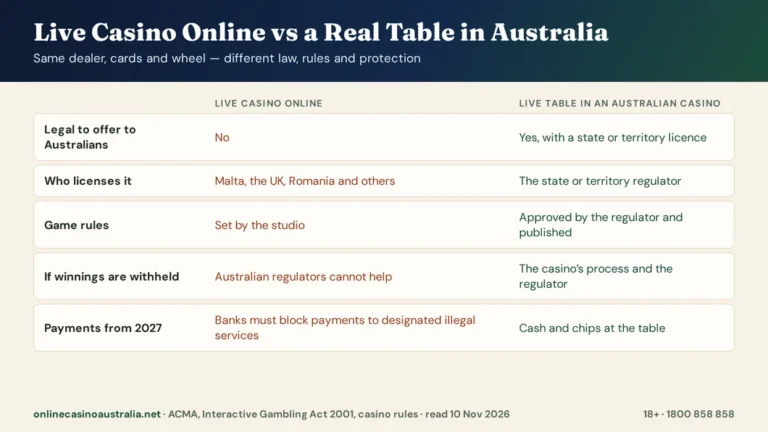
Live dealer blackjack is dealt by a real person in a studio and streamed to your screen, but you place your bets online and play for money. It is still an online casino-style game, so the same rule applies. The studios that run these games are licensed in places such as Malta and the United Kingdom, not in Australia. Our guide to live casino in Australia covers who makes these games and where they are filmed.
Who the law targets
The offences in the Act are aimed at the companies that provide or advertise prohibited services, not at the players who use them. The ACMA is direct about the consequence: if you use an illegal service, “Australian regulators will not be able to help you” if the provider treats you poorly or withholds your winnings. From 1 January 2027, Australian banks and payment systems must also block payments to designated illegal gambling services. Our guide to whether online gambling is legal in Australia covers the full law and the 2027 changes.
Electronic blackjack inside a casino
The Act excludes electronic gaming equipment that a licensed operator provides on its own premises. That is why electronic and semi-automated table games inside Australian casinos are legal while the same game on a website is not: the licence belongs to the venue, not to the game.
Free blackjack apps
Blackjack apps played with virtual chips are sold in Australian app stores. Since 22 September 2024, video games with simulated gambling have been classified R 18+ and restricted to adults (Australian Classification). An R 18+ rating tells you who a game is for; it does not make real-money online play legal. For practising strategy, a physical deck of cards and the charts below work just as well.
Live Dealer Blackjack: Who Runs It
Live dealer blackjack is produced by game studios and supplied to online casinos. The two best known are Evolution, whose timeline lists studios in Riga, Malta, Tbilisi, the United States and other countries and which holds Malta Gaming Authority and UK Gambling Commission licences, and Pragmatic Play Live, which runs a studio in Bucharest under licences from Malta, the UK and Romania.
None of those licences covers players in Australia. A live table streamed from Riga or Bucharest and played for money from Sydney is an online casino game under the Interactive Gambling Act, whatever the quality of the stream or the dealer. If you want to play blackjack with a real dealer and real cards legally, the place to do it is an Australian casino.
Where Australians Play Blackjack Legally
Blackjack is played legally at the land-based casinos licensed by each state and territory. These are the casinos operating in Australia when we checked in November 2026, with the source of the blackjack rules we read for this guide.
| State or territory | Casinos | Blackjack rules we used |
|---|---|---|
| Victoria | Crown Melbourne | Crown Melbourne Blackjack Rules, version 29.0, approved by the VGCCC on 5 May 2026 |
| New South Wales | Crown Sydney · The Star Sydney | Crown Sydney Game Rules – Blackjack, version 4.5 (NSW Independent Casino Commission, June 2026) · The Star’s official guide |
| Queensland | The Star Brisbane · The Star Gold Coast · The Reef Hotel Casino (Cairns) · The Ville (Townsville) | Queensland Casino Gaming Rule, in force from 24 December 2025 |
| Western Australia | Crown Perth | Crown Perth Rules of the Authorised Games of Blackjack, updated 18 May 2026 |
| South Australia | SkyCity Adelaide | SkyCity Adelaide blackjack page and rules |
| Tasmania | Wrest Point (Hobart) · Country Club (Launceston) | — |
| Northern Territory | Mindil Beach Casino Resort (Darwin) · Lasseters (Alice Springs) | — |
| ACT | Casino Canberra | — |
Treasury Brisbane’s casino has closed; its website now directs players to The Star Brisbane. Table minimums are not part of the rules: Crown Melbourne’s rules and the Victorian Casino Control Act require them to be shown on a sign at each table, and Crown Sydney’s rules and Queensland’s rule say the same.
Victoria: Crown Melbourne
Crown Melbourne’s rules document runs to 87 pages and lists more than 30 blackjack variations, from standard blackjack to Crown Pontoon, Blackjack Plus, Spanish Blackjack and Freebet Blackjack. The VGCCC must approve by law any rule or change to table games at the Melbourne casino, and the approved rules are published on Crown’s website.
New South Wales: Crown Sydney and The Star
Crown Sydney’s blackjack rules are set by an order of the NSW Independent Casino Commission. The Star Sydney publishes a three-page guide and lists four blackjack games: Blackjack, Star Blackjack, Blackjack Challenge and Pontoon.
Queensland
Queensland is the only state where we found the rules written into one regulator document for every casino: the Casino Gaming Rule, made under section 63 of the Casino Control Act 1982. The Star Brisbane publishes it as the legally binding rules of its casino operations. Its blackjack schedule requires each table to display “blackjack pays 3 to 2”, “dealer must stand on 17 and must draw to 16” and “insurance pays 2 to 1”.
Western Australia: Crown Perth
Crown Perth’s rules are approved under section 22 of the Casino Control Act 1984 (WA). They are the strictest we read on one point — a dealer blackjack takes doubles and splits as well as the original bet — and they let the dealer hit soft 17 on some table layouts.
South Australia: SkyCity Adelaide
SkyCity Adelaide deals all cards face up and draws the dealer’s second card after all players finish. Its page states that if the dealer gets blackjack, “the original and the double bet are both lost”. It also runs Party Blackjack and Freebet Blackjack, covered in the variants section below.
How Blackjack Works
The goal
You play against the dealer, not against the other players at the table. Each hand starts with a bet in your box. The aim is to finish with a total closer to 21 than the dealer’s without going over. Go over 21 and you “bust” — your bet is lost immediately, even if the dealer busts later.
Card values
| Card | Value |
|---|---|
| 2 to 9 | Face value |
| 10, Jack, Queen, King | 10 |
| Ace | 1 or 11, whichever is better for the hand |
A hand with an ace counted as 11 is a soft hand — an ace and a 6 is “soft 17” — because it cannot bust with the next card. A hand without an ace counted as 11 is a hard hand.
Hard and soft hands in practice
Ace and 6 is soft 17: draw a 5 and the ace counts as 1, giving hard 12, so you cannot bust on that card. Ten and 7 is hard 17: any card higher than a 4 busts it. Ace and ace is soft 12 — which is why you split it. A soft hand becomes hard the moment the ace has to count as 1 to keep the total at 21 or under.
The deal in Australian casinos
This is where Australian blackjack differs from the game in most strategy books. Every player receives a first card, the dealer receives one face-up card, and every player then receives a second card. The dealer takes no second card yet — there is no “hole card” to check. Crown Melbourne’s rules describe it exactly: the dealer takes one card, players take their second card, and the dealer’s second card comes after players act.
Your options
- Hit: take another card. You can keep hitting until you stand or bust.
- Stand: keep your total and end your turn.
- Double: add a bet equal to your original and take exactly one more card. In the casinos we read, you can double only on a first-two-card total of 9, 10 or 11.
- Split: if your first two cards are a pair, add a second bet and play them as two hands. Split aces receive one card each.
Insurance and even money
When the dealer’s card is an ace, you can take insurance: a side bet of up to half your bet that pays 2 to 1 if the dealer makes blackjack. If you have a blackjack against a dealer ace, the dealer may offer even money instead — Crown Melbourne’s rules allow it. Both are the same bet in different clothes, and the maths section below shows why they lose money over time.
How the dealer plays
The dealer has no choices. In the standard game at every casino we read, the dealer must draw to 16 and stand on 17 or more, including soft 17. Some variations, such as “Crown Blackjack” and some table layouts at Crown Perth, make the dealer hit soft 17 — the table sign tells you which game you are at.
Payouts
| Result | Pays | A$10 bet returns |
|---|---|---|
| Blackjack (ace + 10-value card) | 3 to 2 | A$25 (A$15 win + your A$10) |
| Win | 1 to 1 | A$20 |
| Push (tie) | Bet returned | A$10 |
| Insurance win | 2 to 1 | A$5 insurance wins A$10 |
| Blackjack at Party Blackjack (SkyCity) | 6 to 5 (1.2×) | A$22 (A$12 win + your A$10) |
How a Round Is Dealt, Step by Step
- Bets. Every player places a bet in a box, within the limits on the table sign.
- First cards. The dealer gives each player one card face up, then takes one face-up card.
- Second cards. Each player receives a second card. The dealer does not take one — there is no hole card.
- Blackjacks. A player with an ace and a 10-value card has blackjack. At The Star it is paid at once unless the dealer shows an ace or a 10; at Blackjack Plus tables it is paid immediately.
- Insurance. If the dealer shows an ace, players may take insurance or, with a blackjack, even money.
- Decisions. Players act in turn — hit, stand, double or split — until each hand stands or busts.
- The dealer’s turn. The dealer draws a second card and keeps drawing to 17 under the table’s rule.
- Settlement. Winning bets are paid, losing bets collected and pushes returned — with the dealer blackjack rule of that casino applied to doubles and splits.
The order matters for one reason: in a no-hole-card game you make every decision before you know whether the dealer has blackjack. That is the root of every rule difference in the next section.
Blackjack Rules in Australian Casinos Compared
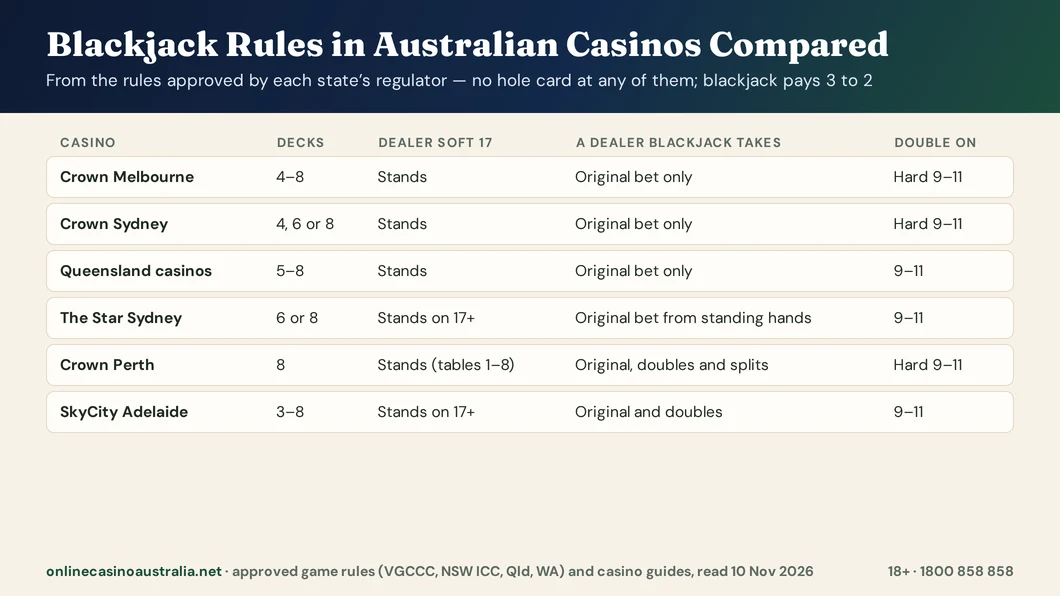
No single public source compares the approved blackjack rules of Australia’s casinos side by side, so we built the table from the documents themselves. Every cell below comes from the casino’s approved rules or its official guide, read on 10 November 2026.
| Casino | Decks | Dealer and soft 17 | A dealer blackjack takes | Double on | Splits |
|---|---|---|---|---|---|
| Crown Melbourne | 4–8 | Stands on all 17s | Original bet only | Hard 9–11, also after splits | Up to 3 hands; aces once |
| Crown Sydney | 4, 6 or 8 | Stands on soft 17 | Original bet only (doubles and splits) | 9–11 | — |
| Queensland casinos | 5–8 | Stands on 17 | Original bet only; extra wagers void | 9–11, also on split hands | No re-splitting; aces one card each |
| The Star Sydney | 6 or 8 | Stands on 17 or more | Original bet from hands still standing | 9–11 (ace counts as one) | — |
| Crown Perth | 8 (4, 6 or 8 where Crown Pairs is offered) | Stands on tables 1–8; hits on 9–14 | Original, doubles and splits | Hard 9–11, also after splits | Up to 3 hands; aces may be re-split |
| SkyCity Adelaide | 3–8 | Stands on 17 or more | Original and double | 9–11 | Up to 3 hands; aces to two hands |
What every casino has in common
No hole card, blackjack paid at 3 to 2 on standard tables, doubles restricted to 9, 10 or 11, and a dealer who stands on 17 in the standard game. The deck count varies from three to eight, which makes little difference: the Wizard of Odds puts the gain from six decks instead of eight at 0.02% of each bet.
Where they differ
The big difference is the dealer blackjack rule, covered in the next section. After that come the dealer’s soft 17 (standard games stand, some variants and Crown Perth’s tables 9 to 14 hit), and split rules: Queensland allows no re-splitting, Crown Perth lets you re-split aces, and Crown Melbourne allows up to three hands.
Older sources can be out of date
Rules change, and some widely read references lag behind. The Wizard of Odds’ notes on Crown Melbourne still describe a dealer who hits soft 17, based on an article from around 2008. Crown Melbourne’s current approved rules (version 29.0, May 2026) say the dealer stands on all 17s in standard blackjack; only the “Crown Blackjack” variation hits soft 17. Always check the current rules document or the table sign.
Splitting and Doubling: The Rules in Detail
Beyond the dealer blackjack rule, the casinos we read differ on how far you can split and when you can double. These details move the house edge by fractions of a percent, but they decide what you are allowed to do at the table.
Crown Melbourne
You can split up to three hands. Aces can be split only once and receive one card each. You can double on hard 9, 10 or 11, including on the first two cards of split hands.
Queensland casinos
Queensland’s Casino Gaming Rule allows no re-splitting. Split aces receive one card each. You can double down on 9, 10 or 11, including on split hands.
Crown Perth
Up to three split hands are allowed and split aces may be re-split. You can double on hard 9, 10 or 11, also after splitting, and the double must equal the original bet.
SkyCity Adelaide
You can split up to three hands; aces only to two hands, with one card each.
The Star Sydney
You can double only on a first-two-card total of 9, 10 or 11, and an ace counts as one when doubling. In practice that rules out the soft doubles that American charts recommend (an ace with a 2 to 7), and the soft hands that do qualify — ace and 8, ace and 9 — are soft 19 and 20, which you should stand on.
The Rule That Matters Most: What a Dealer Blackjack Takes
In casinos with a hole card, the dealer checks for blackjack before you act, so you never double or split into a dealer blackjack. Without a hole card, you make your decisions first — and the dealer may then turn a blackjack. Each casino decides what happens to the extra money you put out.
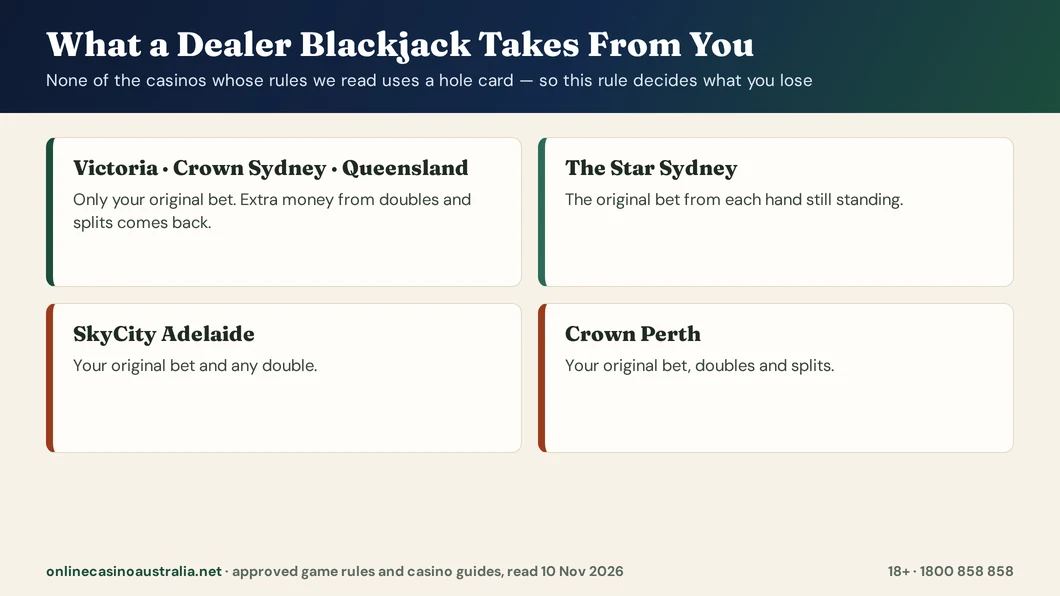
Original bet only: Victoria, Crown Sydney and Queensland
At Crown Melbourne, if the dealer gets blackjack after you double or split, you lose only the original bet. Crown Sydney’s rules say the same, and Queensland’s rule makes the extra wager void. For strategy, this is as good as a hole-card game: you can double and split freely, because the extra money is never at risk against a dealer blackjack.
The Star Sydney
At The Star, the dealer takes only an amount equal to the original bet from the bets still in each box; hands that have already busted are lost. In practice this works like the original-bet-only rule for hands still in play.
When doubles and splits are lost too: Crown Perth and SkyCity Adelaide
Crown Perth’s rules say a split wager loses to a dealer blackjack, and a double loses whenever the original wager loses. SkyCity Adelaide states that the original and the double bet are both lost. Here, doubling or splitting against a dealer 10 or ace puts more money at risk of an outcome you cannot see coming, and four plays change as a result.
| Your hand | Dealer shows | Victoria, NSW, Queensland | Crown Perth (and doubles at SkyCity) |
|---|---|---|---|
| Hard 11 | 10 | Double | Hit |
| Pair of 8s | 10 | Split | Hit |
| Pair of 8s | Ace | Split | Hit |
| Pair of aces | Ace | Split | Hit |
Everything else in the strategy charts stays the same. The Wizard of Odds puts the cost of the lose-everything rule at about 0.11% of each bet; our own calculation gives a difference of 0.11% between the two rule sets as well.
Basic Strategy for Australian Blackjack
Basic strategy is the set of plays that loses the least over time for every combination of your hand and the dealer’s card. It does not win every hand, and it does not remove the house edge. It does remove the extra losses that come from guessing. We calculated it ourselves for the rules used in Victoria, at Crown Sydney and in Queensland: dealer stands on soft 17, blackjack pays 3 to 2, doubles on 9 to 11 only, double after a split allowed, and a dealer blackjack takes only the original bet.
How to read the charts
Find your hand on the left and the dealer’s up-card across the top. H means hit, S means stand, D means double (hit if you have more than two cards), and P means split. Hard 5 to 7 always hit; hard 18 or more always stand; soft 21 is blackjack or simply stands.
Hard totals
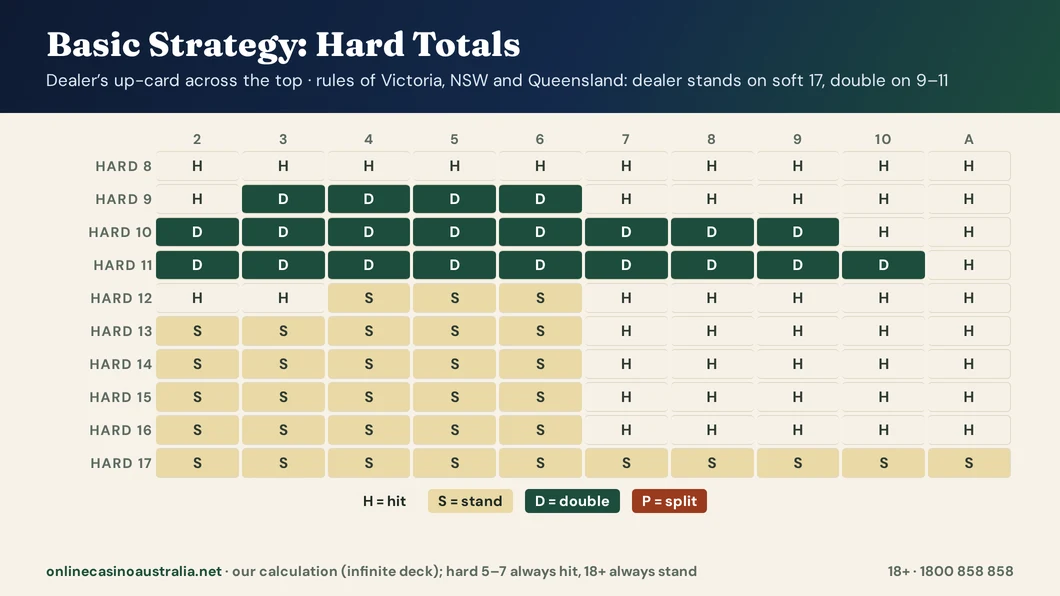
| Your hand | 2 | 3 | 4 | 5 | 6 | 7 | 8 | 9 | 10 | A |
|---|---|---|---|---|---|---|---|---|---|---|
| Hard 8 | H | H | H | H | H | H | H | H | H | H |
| Hard 9 | H | D | D | D | D | H | H | H | H | H |
| Hard 10 | D | D | D | D | D | D | D | D | H | H |
| Hard 11 | D | D | D | D | D | D | D | D | D | H |
| Hard 12 | H | H | S | S | S | H | H | H | H | H |
| Hard 13 | S | S | S | S | S | H | H | H | H | H |
| Hard 14 | S | S | S | S | S | H | H | H | H | H |
| Hard 15 | S | S | S | S | S | H | H | H | H | H |
| Hard 16 | S | S | S | S | S | H | H | H | H | H |
| Hard 17 | S | S | S | S | S | S | S | S | S | S |
The pattern is easier than the grid looks. Against a dealer 2 to 6 — the cards most likely to bust the dealer — you stand on 13 or more and on 12 against a 4, 5 or 6. Against a 7 or higher, you hit until you reach 17. Double 10 and 11 against anything except a 10 or an ace (11 also doubles against a 10 here), and double 9 against a 3 to 6.
Soft hands
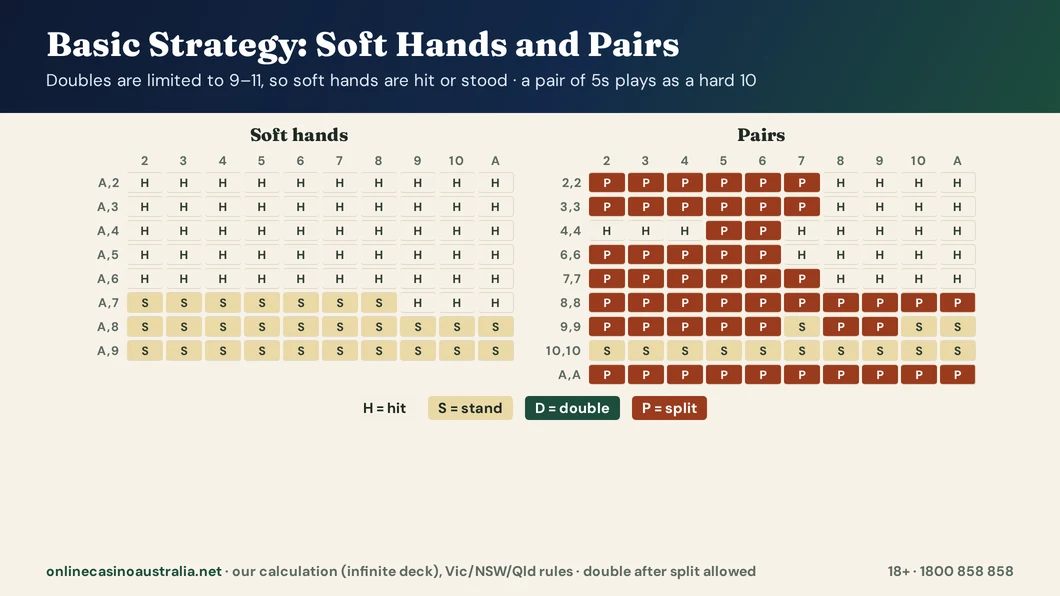
| Your hand | 2 | 3 | 4 | 5 | 6 | 7 | 8 | 9 | 10 | A |
|---|---|---|---|---|---|---|---|---|---|---|
| A,2 (soft 13) | H | H | H | H | H | H | H | H | H | H |
| A,3 (soft 14) | H | H | H | H | H | H | H | H | H | H |
| A,4 (soft 15) | H | H | H | H | H | H | H | H | H | H |
| A,5 (soft 16) | H | H | H | H | H | H | H | H | H | H |
| A,6 (soft 17) | H | H | H | H | H | H | H | H | H | H |
| A,7 (soft 18) | S | S | S | S | S | S | S | H | H | H |
| A,8 (soft 19) | S | S | S | S | S | S | S | S | S | S |
| A,9 (soft 20) | S | S | S | S | S | S | S | S | S | S |
Australian rules make soft hands simpler than in most strategy books: because you can double only on 9, 10 or 11, the soft doubles in American charts (an ace with a 2 to 7) become plain hits. Hit every soft hand up to soft 17. Stand on soft 18 against a 2 to 8 and hit it against a 9, 10 or ace. Stand on soft 19 and 20.
Pairs
| Your hand | 2 | 3 | 4 | 5 | 6 | 7 | 8 | 9 | 10 | A |
|---|---|---|---|---|---|---|---|---|---|---|
| 2,2 | P | P | P | P | P | P | H | H | H | H |
| 3,3 | P | P | P | P | P | P | H | H | H | H |
| 4,4 | H | H | H | P | P | H | H | H | H | H |
| 5,5 | D | D | D | D | D | D | D | D | H | H |
| 6,6 | P | P | P | P | P | H | H | H | H | H |
| 7,7 | P | P | P | P | P | P | H | H | H | H |
| 8,8 | P | P | P | P | P | P | P | P | P | P |
| 9,9 | P | P | P | P | P | S | P | P | S | S |
| 10,10 | S | S | S | S | S | S | S | S | S | S |
| A,A | P | P | P | P | P | P | P | P | P | P |
Always split aces and 8s under these rules. Never split 10s — 20 is too good a hand to break up — and treat a pair of 5s as a hard 10. Split 2s, 3s and 7s against a 2 to 7, 6s against a 2 to 6, 4s only against a 5 or 6, and 9s against everything except a 7, 10 or ace.
Changes for Crown Perth and SkyCity Adelaide
Where a dealer blackjack takes doubles and splits, four plays change: hit hard 11 against a dealer 10 instead of doubling, hit a pair of 8s against a 10 or an ace instead of splitting, and hit a pair of aces against a dealer ace. SkyCity Adelaide publishes the double rule but its page does not cover splits, so for its doubling decisions follow the Perth column.
Never take insurance
Insurance pays 2 to 1 and wins only when the dealer’s second card is a 10-value card. Four of the thirteen card ranks are worth 10, so insurance wins about 31% of the time and loses about 69%. On every A$1 of insurance you lose on average 7.7 cents. Even money on your own blackjack is the same bet, so the same answer applies: decline it.
A Round Played Two Ways: Melbourne and Perth
The dealer blackjack rule is easiest to understand with money on the table. Take the same round in two casinos, with an A$20 bet.
The hands
You are dealt a pair of 8s. The dealer shows a 10. Basic strategy for Victoria says split; for Crown Perth it says hit. Suppose you split, putting up another A$20, and draw a 10 on each 8 to make two hands of 18. The dealer then draws an ace: blackjack.
| Crown Melbourne (original bet only) | Crown Perth (dealer takes all bets) | |
|---|---|---|
| Money in play | A$40 (two hands of A$20) | A$40 (two hands of A$20) |
| Dealer blackjack takes | A$20 — the original bet | A$40 — both split hands |
| Returned to you | A$20 (the second split bet) | A$0 |
| Result of the round | −A$20 | −A$40 |
The same decision cost twice as much in Perth. That is why the Perth chart tells you to hit 8s against a 10 there: the extra bet is exposed to a dealer blackjack you cannot see coming.
A good double
Now take hard 11 against a dealer 6, again for A$20. In every casino we read, the correct play is to double. You add A$20 and receive one card. The dealer cannot have blackjack with a 6 showing, so the only question is whether your one card beats the dealer’s final total — and with a 6 showing, the dealer busts about 42% of the time. Over many hands, this double returns about 33 cents per dollar of the original bet more than simply hitting would, and 82 cents more than standing — one of the most valuable plays in the game.
A hand to leave alone
Finally, hard 16 against a dealer 10. Hit and you bust 62% of the time; stand and the dealer, already showing 10, finishes with 17 or more most of the time. Our calculation puts both choices at about −54 cents per dollar. Hitting is better by a tenth of a cent. It is the most argued-about hand in blackjack, and the argument barely matters.
The Reasons Behind the Chart
A chart is easier to remember when you know why each play is right. These are the reasons, with our calculated values per A$1 bet under Victoria, NSW and Queensland rules.
Hit 12 against a 2 or 3, stand against a 4 to 6
Against a 2, standing on 12 loses about 29 cents per dollar and hitting about 25 cents. Against a 3 the gap narrows to under 2 cents, and against a 4 standing becomes slightly better. The dealer’s bust chance climbs from 35% with a 2 to 39% with a 4, and that small change is enough to flip the decision.
Double 9 only against a 3 to 6
With 9 against a dealer 2, hitting is worth about +7.4 cents and doubling about +6.1 cents, so you hit. Against a 3, doubling moves ahead (+12.1 against +10.1). Against a 7, the dealer’s strong position makes hitting far better (+17.2) than doubling (+10.4).
Do not double 10 against a 10 or an ace
Against a dealer 10, hitting 10 is worth about +2.5 cents and doubling −0.9 cents; against an ace, +8.1 against −1.4. Against a 9, doubling is ahead again (+14.4 against +11.7). The dealer’s 10 or ace is simply too strong to double into with one card.
Stand on a pair of 9s against a 7
A pair of 9s is 18. Against a dealer 7, whose most likely finish is 17, standing on 18 is worth about +40 cents and splitting about +37. Against an 8, the dealer’s most likely total is 18, so splitting (+21.5) beats standing (+10.6).
Hit soft 18 against a 9, 10 or ace
Soft 18 cannot bust on the next card. Against a dealer 9, standing on 18 is worth about −18 cents and hitting about −10 cents, because 18 loses to the dealer’s likely 19. Against an 8, standing is better (+10.6 against +4.0).
Never split 10s, always split aces
Two 10s make 20, worth about +70 cents against a dealer 6 when you stand; splitting them is worth about +58. A pair of aces is the opposite: as a soft 12 it is a weak hand, but split into two hands that each start with an ace it is worth about +67 cents against a 6.
Strategy Cheat Sheet: Ten Rules That Cover Most Hands
If the full charts are too much for your first visit, these ten rules capture most of their value under Victoria, NSW and Queensland rules. Exceptions for Crown Perth are in brackets.
- Always split aces and 8s (in Perth, hit 8s against a 10 or an ace, and aces against an ace).
- Never split 10s or 5s — treat 5s as a hard 10.
- Double 11 against every card except an ace (in Perth, also not against a 10).
- Double 10 against 2 to 9.
- Double 9 against 3 to 6; otherwise hit.
- Stand on 17 or more, always.
- Stand on 13 to 16 against a dealer 2 to 6; hit them against 7 or higher.
- Stand on 12 only against a 4, 5 or 6.
- Hit soft 17 or less; stand on soft 18 against 2 to 8 and hit it against 9, 10 or an ace.
- Never take insurance or even money.
Played this way, you give away very little to perfect basic strategy — the expensive errors in our mistakes table are almost all broken versions of rules 1, 3, 4, 7 and 10.
What Common Mistakes Cost
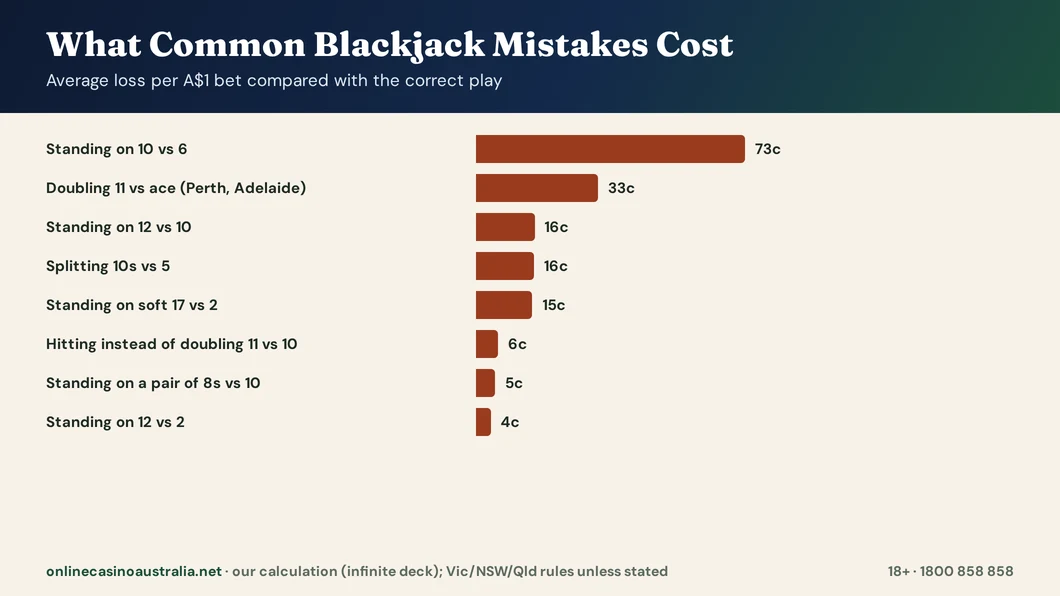
Small errors add up because blackjack is played hand after hand. We calculated the average cost of the most common ones, per A$1 bet on the hand, against the correct play.
| Mistake | Correct play | Average cost per A$1 |
|---|---|---|
| Standing on 10 against a dealer 6 | Double | 72.9 cents |
| Doubling 11 against a dealer ace (Perth, Adelaide) | Hit | 33.1 cents |
| Standing on 12 against a dealer 10 | Hit | 15.9 cents |
| Splitting 10s against a dealer 5 | Stand | 15.8 cents |
| Standing on soft 17 against a dealer 2 | Hit | 15.2 cents |
| Hitting instead of doubling 11 against a dealer 10 | Double | 6.0 cents |
| Standing on a pair of 8s against a dealer 10 (instead of splitting) | Split | 5.1 cents |
| Standing on 12 against a dealer 2 | Hit | 3.9 cents |
| Splitting 8s against a dealer 10 (Perth, Adelaide) | Hit | 3.9 cents |
| Doubling 11 against a dealer 10 (Perth, Adelaide) | Hit | 2.1 cents |
| Hitting 12 against a dealer 6 | Stand | 1.7 cents |
| Standing on 16 against a dealer 10 | Hit | 0.1 cents |
The mistakes that cost the most
Refusing a good double is the most expensive habit: standing on 10 against a dealer 6 gives back 73 cents of every dollar compared with doubling. Splitting 10s against a weak dealer card feels clever and costs 16 cents. In Perth and Adelaide, doubling 11 into a dealer ace costs 33 cents, because the dealer will turn a blackjack almost a third of the time and take both bets.
The mistakes that hardly matter
Standing on 16 against a dealer 10 is the hand players argue about most, and it is close to a coin toss: hitting is better by only 0.1 cents per dollar. Both choices lose about 54 cents per dollar on average. The lesson is not that 16 against a 10 is a good hand — it is that no play saves it.
How Often the Dealer Busts
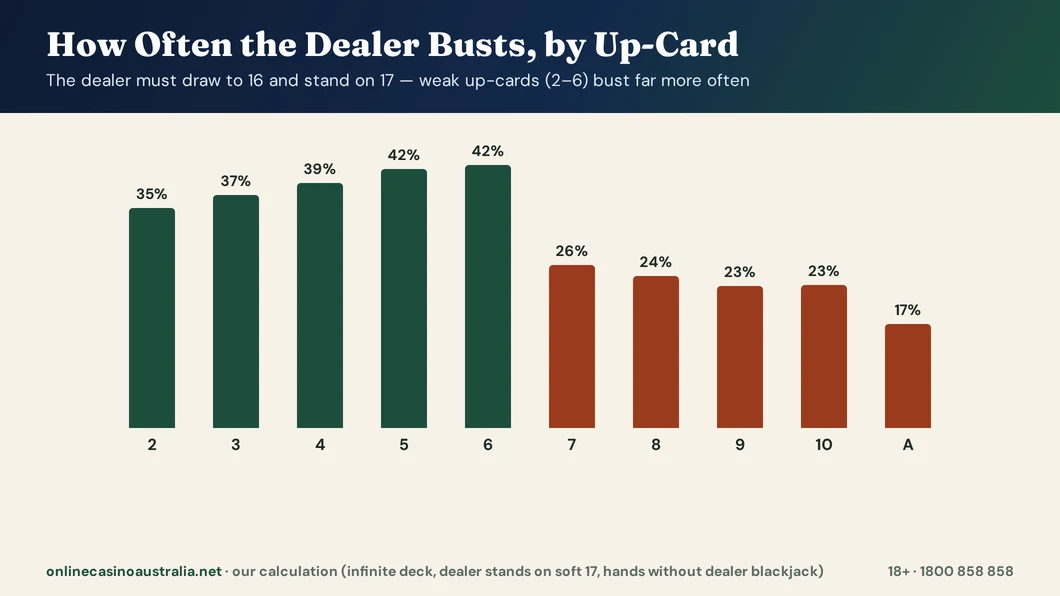
The dealer’s up-card tells you more than anything else at the table, because the dealer must keep drawing to 17. With a 4, 5 or 6 showing, the dealer will finish over 21 roughly two times in five. With a 7 or higher, the chance falls to about one in four or less.
| Dealer shows | Busts | Most likely final total |
|---|---|---|
| 2 | 35.4% | Bust |
| 3 | 37.4% | Bust |
| 4 | 39.4% | Bust |
| 5 | 41.6% | Bust |
| 6 | 42.3% | Bust |
| 7 | 26.2% | 17 |
| 8 | 24.5% | 18 |
| 9 | 22.8% | 19 |
| 10 | 23.0% | 20 |
| A | 16.7% | 17 to 20, about evenly |
These are our own figures for a dealer who stands on soft 17, counting only rounds in which the dealer does not have blackjack. They explain most of basic strategy: you stand on stiff hands against a 2 to 6 because the dealer is likely to bust, and you hit them against a 7 or higher because the dealer is likely to finish with 17 or more.
How often you get a blackjack
A blackjack needs an ace and a 10-value card in your first two cards. That happens in about 4.7% of hands — roughly once every 21 hands. Over a session of 100 hands, expect around five, and remember that a dealer blackjack is exactly as likely.
Blackjack Probabilities Worth Knowing
A few numbers explain most of what happens at a blackjack table. These are our own calculations from card frequencies: four of the thirteen ranks — 10, jack, queen and king — count as 10.
| Situation | Probability |
|---|---|
| You are dealt a blackjack | 4.7% — about 1 hand in 21 |
| Dealer shows an ace and turns a blackjack | 30.8% |
| Dealer shows a 10 and turns a blackjack | 7.7% |
| You bust when hitting hard 12 | 30.8% |
| You bust when hitting hard 13 | 38.5% |
| You bust when hitting hard 14 | 46.2% |
| You bust when hitting hard 15 | 53.8% |
| You bust when hitting hard 16 | 61.5% |
| You bust when hitting hard 17 | 69.2% |
| Insurance wins | 30.8% |
Why you still hit 12 against a 10
Hitting hard 12 busts you almost a third of the time, which feels reckless. Standing is worse: a dealer showing 10 finishes with 17 or more about 77% of the time, and a 12 beats none of those totals. Our figures put hitting 12 against a 10 about 16 cents per dollar ahead of standing.
Why the dealer’s ace is so dangerous
With an ace showing, the dealer turns a blackjack almost a third of the time. In Victoria, NSW and Queensland that costs you only your original bet, so you still play your hand normally. In Perth, where doubles and splits are lost too, it is the reason to stop doubling 11 and splitting 8s and aces against an ace.
When the Dealer Shows an Ace
The dealer’s ace is the most important card at the table, and Australian rules make it more so. With no hole card, nobody knows whether the dealer has blackjack until the end of the round — and with an ace showing, the dealer will turn one about 31% of the time.
The insurance offer
The dealer will offer insurance before players act. It pays 2 to 1 if the dealer’s second card is a 10-value card. Because only four of thirteen ranks count as 10, it loses on average about 7.7 cents for each dollar staked. That is true whatever your own hand is, including a blackjack, where the offer is called even money.
Playing your hand against an ace
In Victoria, NSW and Queensland, play your hand normally: if the dealer has blackjack, only your original bet is lost and any doubles or splits are returned. At Crown Perth, where doubles and splits are lost too, stop doubling 11 and splitting 8s and aces against an ace — hit instead.
Why the ace still beats the player
Even without blackjack, a dealer ace finishes with a total of 17 to 21 most of the time and busts only about 17% of the time in rounds without a dealer blackjack. It is the up-card against which every player hand is worth least.
The House Edge in Australian Blackjack
The house edge is the share of each bet the casino keeps on average over a very large number of hands. With perfect basic strategy, blackjack has one of the lowest edges in a casino — but only on standard tables.
The published figure
The Wizard of Odds puts the house edge at 0.59% for the rules he recorded at Star City in Sydney: eight decks, dealer stands on soft 17, double on 9 to 11, double after split, one split only, and the original-bet-only rule on a dealer blackjack (Wizard of Odds). That is the most complete published calculation for Australian rules that we found.
Our calculation for today’s rules
Using an infinite-deck model — a close approximation of an eight-deck shoe — we get a house edge of about 0.66% for the rules used in Victoria, at Crown Sydney and in Queensland, and about 0.77% for Crown Perth’s rule that a dealer blackjack takes doubles and splits. Our model does not include re-splitting, which most of these casinos allow, so the real figures are slightly lower. The difference between the two rule sets, 0.11%, is the part that matters.
How each rule changes the edge
| Rule | Effect on the player’s return |
|---|---|
| Blackjack pays 6 to 5 instead of 3 to 2 | −1.39% |
| Dealer hits soft 17 | −0.22% |
| No hole card, dealer takes all bets | −0.11% |
| No re-splitting of pairs | −0.10% |
| Double on 9 to 11 only | −0.09% |
| Six decks instead of eight | +0.02% |
| Dealer 22 is a push (rule on its own) | −6.91% |
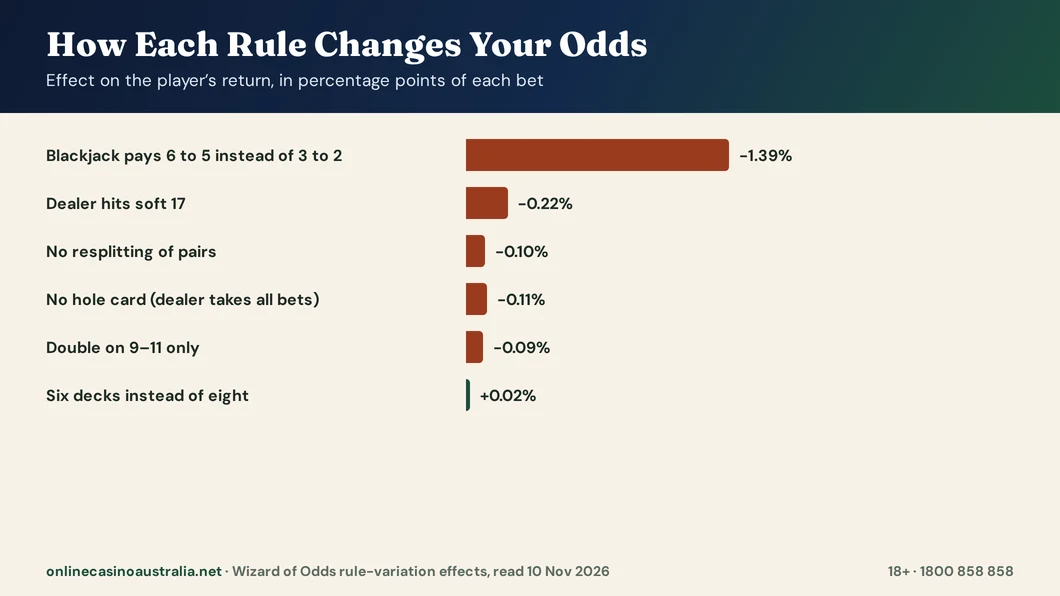
The 6 to 5 payout is the rule to avoid: on its own it costs more than the whole house edge of a standard game. The dealer-22 push looks enormous because it is the cost of that rule alone; games that use it, such as Blackjack Plus and Freebet Blackjack, give some of it back through other rules. Read the full rule card, not just the headline feature.
What the edge means for a session
| Game | House edge | Expected loss on 100 hands at A$10 |
|---|---|---|
| Standard rules, original bet only (our calculation) | about 0.66% | about A$6.60 |
| Standard rules, dealer takes all bets (our calculation) | about 0.77% | about A$7.70 |
| Same game with 6 to 5 blackjack | about 2.05% | about A$20.50 |
| Playing by hunch instead of strategy | several times higher | — |
Expected loss is an average, not a forecast. In any single session the swings are far larger than the edge: you will often finish well ahead or well behind. The edge only shows itself over thousands of hands — which is exactly how a casino plays.
Blackjack Compared With Other Casino Games
With basic strategy, standard blackjack has one of the lowest house edges on an Australian casino floor. The figures below are the ones published by the casinos or by the Wizard of Odds, and the RTP of a popular pokie from our free pokies guide.
| Game | House edge | Source |
|---|---|---|
| Blackjack, Australian standard rules, basic strategy | about 0.6% | Wizard of Odds (0.59%, Star City rules) |
| Blackjack at 6 to 5 | about 2% | Wizard of Odds rule effect added to the above |
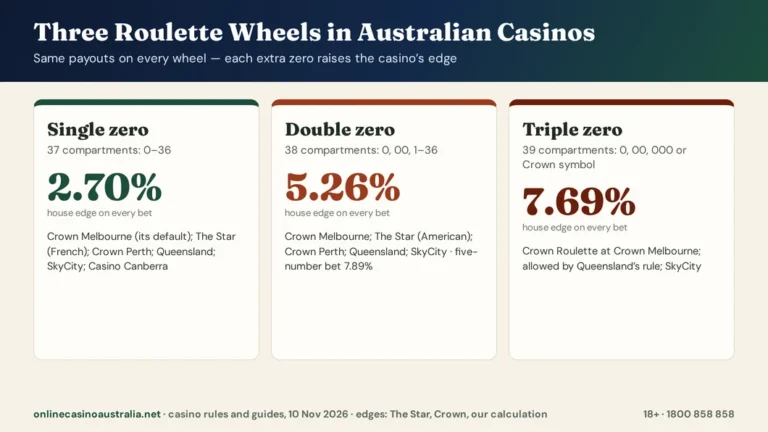
| European roulette (single zero) | 2.70% | The Star; Wizard of Odds |
| American roulette (double zero) | 5.26% | The Star; Wizard of Odds |
| Crown Roulette (39 compartments) | 7.69% | Crown Melbourne game guide |
| Gates of Olympus pokie (96.50% RTP) | 3.50% | Pragmatic Play, via our free pokies guide |
The comparison only holds if you play blackjack well. Hunch play, insurance and 6 to 5 tables can push the edge well above that of a single-zero roulette wheel.
Blackjack at a Glance: The Key Numbers
| What | Figure | Source |
|---|---|---|
| Blackjack payout on standard tables | 3 to 2 | Approved rules of every casino we read |
| Hole card | None — dealer draws after players | Approved rules of every casino we read |
| Doubling allowed on | 9, 10 or 11 | Approved rules of every casino we read |
| House edge with basic strategy | about 0.59% | Wizard of Odds, Star City rules |
| Our calculation, original bet only | about 0.66% | Our infinite-deck model |
| Our calculation, dealer takes all bets | about 0.77% | Our infinite-deck model |
| Chance of a player blackjack | 4.7% | Our calculation |
| Dealer bust chance with a 6 showing | 42.3% | Our calculation |
| Cost of insurance | about 7.7 cents per dollar | Our calculation |
| Cost of a 6 to 5 payout | 1.39% of every bet | Wizard of Odds |
| Blackjack variations in Crown Melbourne’s rules | 30+ | Crown Melbourne Blackjack Rules v29.0 |
If you remember only three of these, make them the 3 to 2 payout, the 7.7-cent cost of insurance, and the dealer blackjack rule of the casino you are in.
Blackjack Variants in Australian Casinos
Australian casino floors carry far more than standard blackjack. Crown Melbourne’s approved rules list more than 30 variations. These are the ones we found described in the rules and guides we read.
| Game | Where we found it | How it differs |
|---|---|---|
| Blackjack Plus | Crown Melbourne, Crown Perth | A dealer total of 22 is a stand-off for all remaining bets; player blackjacks are paid immediately |
| Crown Pontoon | Crown Melbourne | Played with 48-card decks (the four 10s removed); Pontoon pays 3 to 2 |
| Crown Blackjack | Crown Melbourne, Crown Sydney | The dealer hits soft 17 |
| Freebet Blackjack | SkyCity Adelaide; listed at Crown Melbourne | Free doubles on 9 to 11 and free splits; a dealer 22 is a stand-off |
| Party Blackjack | SkyCity Adelaide | Dealer hits soft 17, dealer 22 is a stand-off, and blackjack pays 1.2 times the bet (6 to 5) |
| Others listed | Crown Melbourne | Pontoon Pandemonium, Vegas Blackjack, Spanish Blackjack, Buster Blackjack and a 6 to 5 Pontoon |
| Star Blackjack, Blackjack Challenge, Pontoon | The Star Sydney | Listed by The Star alongside standard Blackjack |
Blackjack Plus
The selling point is that player blackjacks are paid straight away. The cost is the rule that a dealer 22 is a stand-off: every hand that would have won when the dealer busted on 22 becomes a push. Check how the other rules compensate before you sit down.
Pontoon
Australian casino Pontoon is not the British home game of the same name. Crown Pontoon is played with 48-card decks — every 10 removed, leaving jacks, queens and kings — which shifts the odds against the player. Treat it as a separate game with its own strategy and its own pay table.
Freebet Blackjack
Freebet Blackjack gives you doubles on 9 to 11 and splits without putting up extra money. In exchange, a dealer 22 pushes. Because the free doubles and splits are worth taking far more often than paid ones, its strategy differs from standard blackjack.
Party Blackjack and the 6 to 5 trap
Party Blackjack at SkyCity Adelaide pays blackjack at 1.2 times the bet, which is 6 to 5. On an A$10 bet, a blackjack pays A$12 instead of A$15. Combined with a dealer who hits soft 17 and a push on dealer 22, it is a very different game from the standard table next to it, whatever the atmosphere.
Side bets
Many tables add optional side bets: Crown Perth’s rules cover Crown Pairs, and SkyCity Adelaide’s cover Any Pair, Triple Sevens, Buster Blackjack and jackpots. They are separate wagers with their own pay tables, decided by your first cards or by how the dealer busts, and they do not change the main game. Basic strategy has nothing to say about them; the pay table on the table sign is the only guide to what they return.
Choosing a Table in an Australian Casino
Two tables side by side can be very different games. Before you buy in, read the sign and look at the layout.
| On the sign or layout | What you want to see | Why it matters |
|---|---|---|
| Blackjack payout | “Blackjack pays 3 to 2” | 6 to 5 costs about 1.39% of every bet |
| Dealer rule | “Dealer must stand on 17” | Hitting soft 17 costs about 0.22% |
| Game name | Standard blackjack, unless you know the variant’s rules | Variants change the strategy |
| Minimum and maximum bet | A minimum that fits your budget for 20 bets or more | Short budgets end sessions on normal swings |
| Side bets | Optional, and ignored unless you want them | They do not change the main game |
Ask before you sit down
If the sign does not say what happens to doubles and splits on a dealer blackjack, ask the dealer before the first hand. The answer decides which strategy chart applies, and each casino whose rules we read sets it clearly. A dealer will also tell you whether a table uses a shoe or a continuous shuffler.
How to Practise Basic Strategy
- Learn it in blocks. Start with hard totals against a 2 to 6 and a 7 to ace, then soft hands, then pairs.
- Deal yourself hands. A single deck and the charts above are enough: deal a dealer card and two cards for you, decide, then check.
- Say the reason aloud. “Dealer 6, likely to bust, I stand on 13” sticks better than a memorised letter.
- Practise the Australian rules. Most free apps and charts online assume a hole card and soft doubles; use the charts for the casino you will play in.
- Check the expensive plays first. Doubling 10 and 11, splitting aces and 8s, and never taking insurance cover most of the value.
Bankroll and Bet Size
No strategy changes the edge, but bet size changes how long a budget lasts. Losing streaks are normal: in our calculation, a run of five losing hands in a row happens at least once in about three out of four sessions of 100 hands. With a budget of five bets, that run ends the session; with 20 bets or more, it is an ordinary swing.
| Budget for the session | Bet | Number of bets |
|---|---|---|
| A$100 | A$5 | 20 |
| A$200 | A$10 | 20 |
| A$300 | A$10 | 30 |
| A$500 | A$25 | 20 |
Decide the budget before you arrive, keep it separate from other money, and stop when it is gone or when you reach the time you set. Raising your bet to recover losses does not change the house edge — it only makes losses arrive faster.
Blackjack Tournaments
Tournament blackjack is a different contest: players start with the same stack of tournament chips and the winners are those with the most chips after a set number of hands. Crown Perth’s approved rules include a set of rules for Tournament Blackjack alongside standard Blackjack and Blackjack Plus. Because you are playing against the other players’ stacks rather than only the dealer, tournament strategy often departs from basic strategy near the end. Check the entry fee, prize structure and rules before you register.
What Changed in the Rules in 2026
Casino rules are living documents. In the year to November 2026, Crown Melbourne’s blackjack rules reached version 29.0, approved on 5 May 2026 and effective from 20 May; Crown Sydney’s rules were set by a Commission order signed on 24 June 2026; Crown Perth’s were updated on 18 May 2026; and Queensland’s Casino Gaming Rule took effect on 24 December 2025. If you rely on a rule — especially the dealer blackjack rule — check the current version on the casino’s website before you play.
Card Counting and Shuffling Machines
Card counting is not magic and not a trick of memory. It rests on one fact: a shoe rich in 10s and aces favours the player, because blackjacks pay 3 to 2 and the dealer busts more often, while a shoe rich in small cards favours the dealer. A counter keeps a running tally of cards seen and bets more when the remaining cards favour them.
Why it is harder than it looks
With six or eight decks, the shifts are small and arrive late in the shoe. Crown Perth’s rules allow up to eight decks with an automatic shuffler, and a machine that shuffles continuously returns cards to the shoe after every round, so the count never builds up.
What it means for most players
For almost everyone, the useful lesson from counting is the one basic strategy already teaches: the game is decided by maths, not by streaks. Play the chart, size your bets to your budget, and ignore claims that any system can beat a continuous shuffler.
At the Table: Etiquette From the Dealer’s Side
Michael Jones, who wrote this guide, dealt cards at the WIN 333 casino in Calella, Spain, and at poker tournaments including the European Poker Tour in Barcelona. Most friction at a blackjack table comes from the same handful of habits, and dealers notice all of them.
Buying in
Place your cash on the table, not in the dealer’s hand, and wait between rounds. The dealer counts it in view of the cameras and pushes chips to you. Check the table sign for the minimum and maximum bet first — the rules of Crown Melbourne, Crown Sydney and Queensland require limits to be displayed at the table.
Signals, not words
Because cards are dealt face up and the cameras record every hand, dealers act on hand signals: tap the table to hit, wave a flat hand over your cards to stand. Saying “hit” and doing nothing leaves the dealer waiting; a clear signal keeps the game moving and avoids disputes.
Chips and bets
Once the first card is dealt, leave your bet alone. Add chips for a double or a split beside the original bet, not on top of it, so the dealer can see exactly what you did. At The Star Sydney, up to three players may bet on one box, which is how “betting behind” works — the player seated at the box makes the decisions.
Pace and other players
Decide before your turn, especially on a busy table. Other players’ choices do not change your odds: a “bad” hit by someone else is as likely to help you as hurt you. If a table’s mood makes you play faster or bigger than planned, change tables.
Myths About Blackjack
| Myth | What is true |
|---|---|
| “The dealer is due to bust” | Every round starts fresh; the dealer’s chance of busting depends only on the cards |
| “Bad players at the table ruin your odds” | Other players’ decisions change which cards you see, not your average result |
| “Insurance protects a good hand” | Insurance is a separate bet that loses about 7.7 cents per dollar |
| “Always assume the dealer has a 10 underneath” | In Australian casinos there is no card underneath; the dealer draws after you |
| “A licensed online site is legal for Australians” | No online blackjack can legally be offered to people in Australia, whatever licence it shows |
| “A 6 to 5 table is fine for a quick game” | 6 to 5 costs about 1.39% of every bet on its own — more than the whole edge of a standard table |
Online Blackjack vs Casino Blackjack
| Australian casino | Offshore online site | |
|---|---|---|
| Legal to offer to Australians | Yes, under a state or territory licence | No |
| Rules | Approved by the regulator and published | Set by the operator or game studio |
| If something goes wrong | The casino’s process and the state regulator | No Australian regulator can help |
| Payments | Cash and chips at the table | Blocked by Australian banks from 1 January 2027 for designated illegal services |
| Strategy in this guide | Applies directly | Depends on rules that vary by studio |
The comparison is not about which is more fun. It is about which game you can check: an Australian casino’s rules are approved, published and enforced by a regulator you can complain to.
Common Beginner Mistakes
- Sitting at the first free seat. Check the sign for the game, the payout and the limits before you buy in.
- Using a chart for the wrong rules. American charts assume a hole card and soft doubles that Australian tables do not have.
- Taking insurance with a good hand. The quality of your hand does not change what insurance pays.
- Doubling or splitting into a 10 or ace in Perth or Adelaide. A dealer blackjack takes the extra money there.
- Raising bets to win back losses. The edge does not change with your bet size; only the speed of losses does.
- Playing tired or after drinking. Strategy mistakes multiply late at night, and that is when sessions run longest.
A Short Blackjack Glossary
| Term | Meaning |
|---|---|
| Hole card | A face-down second card for the dealer; not used in Australian casinos |
| Soft hand | A hand with an ace counted as 11 |
| Hard hand | A hand with no ace, or an ace counted as 1 |
| Stiff | A hard 12 to 16 — a hand that can bust with one card |
| Push | A tie; your bet is returned |
| Even money | A 1 to 1 payout on your blackjack against a dealer ace, equal to insurance |
| Box | The betting spot on the layout |
| Shoe | The holder for several decks of cards |
| Stand-off | A push declared by a rule, such as a dealer 22 in Blackjack Plus |
| House edge | The average share of each bet the casino keeps |
Keeping Blackjack a Game
Blackjack’s low house edge is the reason it is easy to play for longer than planned. Decide your budget and your stopping time before you sit down, take breaks, and never chase losses. Free, confidential help is available 24 hours a day on 1800 858 858 and at Gambling Help Online. Our responsible gambling guide covers limits and self-exclusion.
Signs a session is going wrong
- You are raising your bet to win back what you have lost.
- You have gone past the time or the budget you set before you sat down.
- You are taking insurance or doubling on hunches you would not make with a clear head.
- You are using money set aside for bills, rent or other people.
- You feel you need to keep playing to make the session “worth it”.
Any one of these is a reason to stand up from the table. Walking away is a strategy decision too — and the only one that guarantees you keep what you have left.
The Bottom Line on Blackjack in Australia
Real-money online blackjack cannot legally be offered to Australians, but the game is alive in every Australian casino under rules approved by the state or territory regulator. Those rules share no hole card, 3 to 2 blackjacks and doubles on 9 to 11, and differ on one point that matters: whether a dealer blackjack takes only your original bet or your doubles and splits too. Learn the chart for the casino you play in, never take insurance, avoid 6 to 5 tables, and set your limits before the first hand.
How We Put This Guide Together
The casino rules in this guide come from the documents themselves, read on 10 November 2026: Crown Melbourne Blackjack Rules version 29.0 (VGCCC approved 5 May 2026), Crown Sydney Game Rules – Blackjack version 4.5 (NSW Independent Casino Commission order of 24 June 2026), the Queensland Casino Gaming Rule (in force from 24 December 2025), Crown Perth’s Rules of the Authorised Games of Blackjack (updated 18 May 2026), SkyCity Adelaide’s blackjack page and rules, and The Star’s official blackjack guide. The law comes from the Interactive Gambling Act 2001 and the ACMA. The basic strategy charts, dealer bust chances, mistake costs and the 0.66% and 0.77% house edges are our own calculations, using an infinite-deck model with the dealer standing on soft 17, doubles on 9 to 11, double after split and no re-splitting; the 0.59% figure and the rule effects are from the Wizard of Odds. Search volumes are Google Ads figures for Australia (DataForSEO, November 2026). Written by Michael Jones — see how we review. 18+ only. If gambling stops being fun, call 1800 858 858.