


Is Online Gambling Legal in Australia? The Short Answer
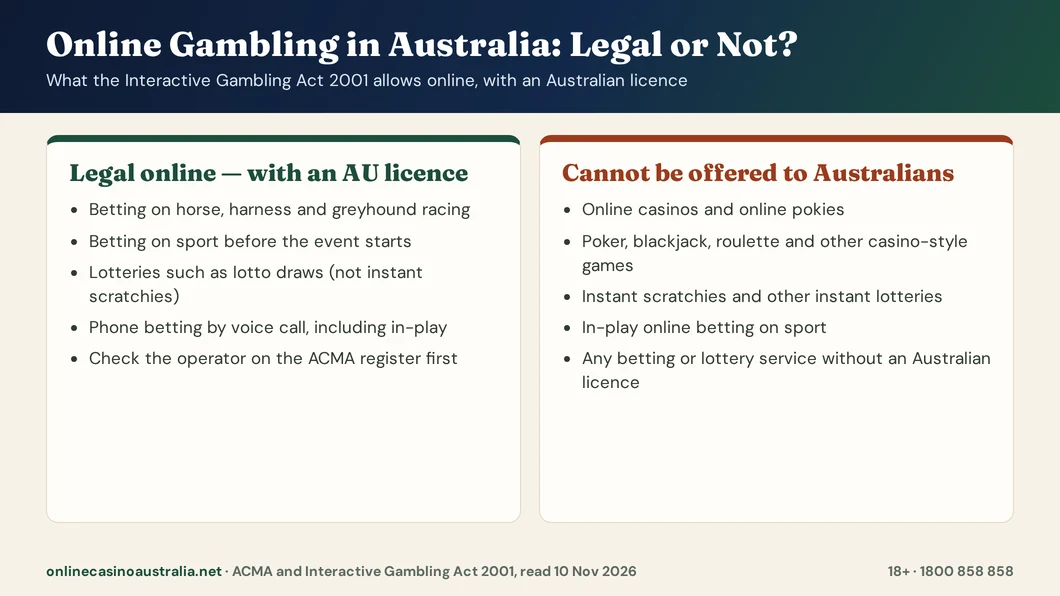
Some of it is. Betting online on racing and on sport before it starts, and buying lottery tickets online, are legal in Australia — as long as the operator holds an Australian state or territory licence. Online casinos, online pokies, poker, blackjack, roulette, instant scratchies and in-play online sports betting cannot legally be offered to people in Australia at all.
That is the line drawn by the Interactive Gambling Act 2001. In the ACMA’s words, the Act “makes it illegal for gambling providers to offer some online services to people in Australia”, and “banned services must not be advertised in Australia”. The law is aimed at the companies that provide and promote these services rather than at the people who use them — but it also means that a player who uses an illegal site has no Australian protection if something goes wrong.
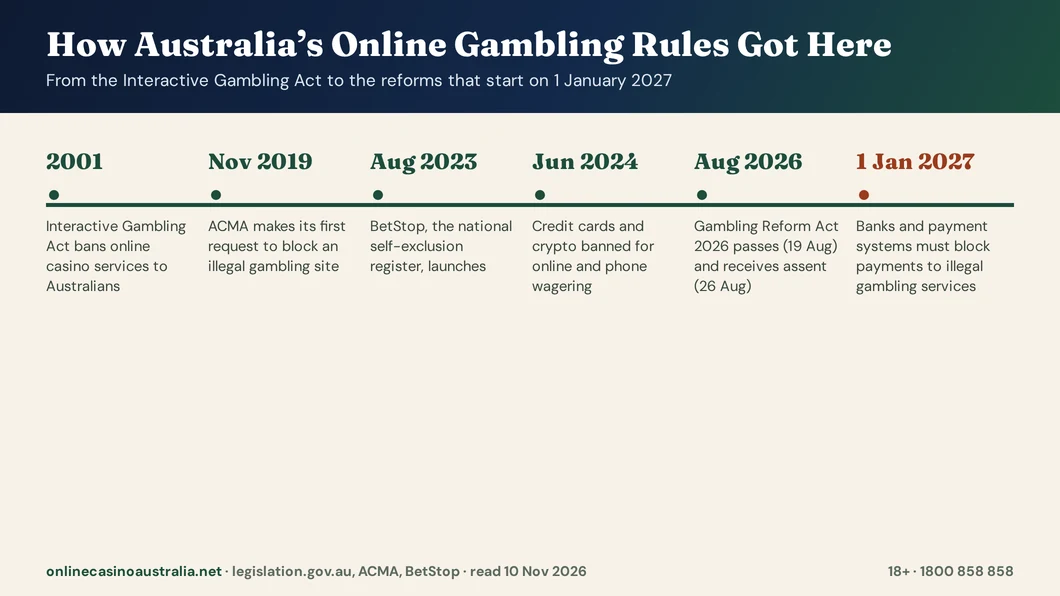
The rules are about to tighten again. Under the Interactive Gambling Amendment (Gambling Reform) Act 2026, passed on 19 August 2026, Australian banks and payment systems must start blocking payments to illegal gambling services from 1 January 2027. This guide explains what is legal, what is not, how the law is enforced, what changes in 2027, and what it all means if you gamble online.
What Is Legal and What Is Not
| Type of gambling | Online in Australia | Who can offer it |
|---|---|---|
| Betting on horse, harness and greyhound racing | Legal | Operators licensed by an Australian state or territory |
| Betting on sport, placed before the event | Legal | Licensed operators |
| In-play betting on sport (during the event) | Not online — by phone call only | Licensed operators, by voice call |
| Lotteries such as lotto draws | Legal | Licensed lottery operators |
| Instant scratchies and other instant lotteries | Cannot be offered online | — |
| Online casinos and online pokies | Cannot be offered | No one: no Australian licence exists |
| Online poker, blackjack, roulette and other casino-style games | Cannot be offered | No one |
| Any betting or lottery service without an Australian licence | Cannot be offered | — |
| Online keno and “foreign-matched” lotteries | Banned from 1 January 2027 | — |
The list of illegal online services comes from the ACMA, which names “slots (pokies); casino-style games (like poker, blackjack and roulette); scratchies; in-play betting on sporting events; betting and lottery services that are not licensed in Australia”. Our guides to blackjack and roulette explain where those games can be played legally instead. The legal categories are written into the Act as exclusions from the ban: telephone betting services, licensed wagering on racing, licensed betting on sport other than in-play, and licensed lotteries other than electronic scratchies and instant lotteries (sections 5, 8A and 8D).
Why pokies are legal in a pub but not on your phone
Poker machines, casinos and lotteries in physical venues are regulated by the states and territories. The Department of Social Services puts it plainly: “State and territory governments regulate ‘land-based gambling’ including poker machines, casinos and lotteries,” while the Commonwealth regulates online gambling. So the same game can be legal on a machine at a licensed club and illegal as an online service. The Act also excludes electronic gaming equipment that a licensed operator provides on its own premises, which is why electronic table games inside casinos are legal.
What “an Australian licence” means
For betting and lotteries, the licence has to come from an Australian state or territory — a licence from Curaçao, Anjouan, Malta or anywhere else does not make a service legal for Australians. The ACMA keeps a register of licensed interactive gambling providers and says: “Before you use any online wagering service over the internet, make sure it is legal. It must be on the register of licensed interactive gambling providers to operate in Australia.” The register had 214 entries when we read it on 10 November 2026. There is no equivalent register for online casinos, because no online casino can be licensed for Australians.
Who the Law Targets: Operators, Promoters and Players
The offences in the Interactive Gambling Act are written around the provider. Section 15 says a person commits an offence if they intentionally provide a prohibited interactive gambling service that has an Australian-customer link, and separate offences cover advertising. None of those offences is directed at the customer who uses the service.
That is not the same as being protected. The ACMA warns: “If you gamble online using a company that operates illegally, you risk losing your money,” and “if you use an illegal service, Australian regulators will not be able to help you” — for example if the provider treats you poorly or withholds your winnings. An offshore casino can close an account, cancel a withdrawal or change its terms, and there is no Australian regulator, ombudsman or self-exclusion scheme that applies to it.
Promoters and websites are covered too
The rules reach beyond the operator. The ACMA says that anyone who helps someone break the rules may face criminal charges or civil penalties, and in October 2026 it warned that individuals who promote or publicise illegal services “can face civil penalties of up to $65,520 per contravention”, while “those who facilitate access to illegal gambling services, including by providing hyperlinks or directing users to those services, may face penalties of up to $2,730,000” (ACMA, 22 October 2026).
Penalties Under the Interactive Gambling Act
| Contravention | Penalty in the Act | In dollars |
|---|---|---|
| Providing a prohibited online gambling service to Australians (s 15) | Criminal offence up to 5,000 penalty units; civil penalty up to 7,500 penalty units — each day counts separately | The ACMA cites up to A$2,730,000 for facilitating access (October 2026) |
| Advertising an illegal online gambling service in Australia (s 61EA) | Offence up to 120 penalty units; civil penalty up to 180 penalty units | Depends on the penalty unit value at the time |
| Promoting or publicising an illegal service | Civil penalty | Up to A$65,520 per contravention (ACMA, October 2026) |
| Banks and payment systems failing to block payments (s 15J, from 1 January 2027) | Civil penalty up to 1,000 penalty units | — |
Dollar amounts move with the Commonwealth penalty unit. The ACMA’s investigations page still lists civil penalties of up to A$2,475,000 per day for an individual and A$12,375,000 per day for a corporation, while its October 2026 warning uses A$2,730,000, which matches 7,500 penalty units at the value in force from 1 July 2026.
The penalties are being imposed
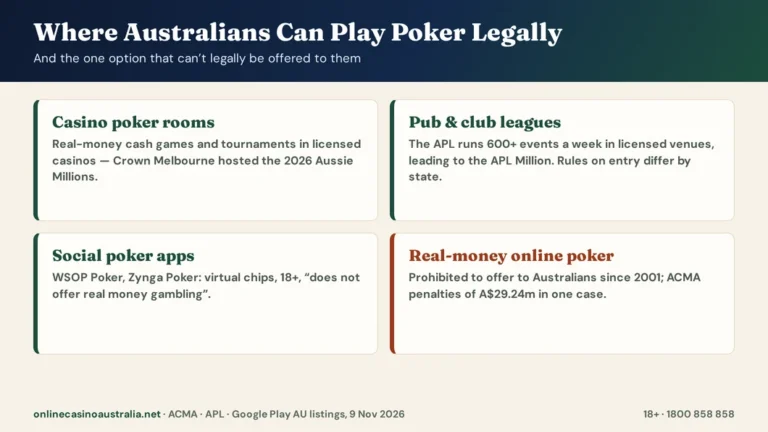
On 6 July 2026 the Federal Court imposed A$24.24 million in penalties on the providers and promoters of the prohibited online poker services PPPfish, Shuffle Gaming and Redraw Poker, bringing total penalties in those proceedings to A$29.24 million (ACMA). Our guide to online poker in Australia covers what that case means for poker players.
How the ACMA Enforces the Law
The ACMA has three main tools: investigations and court action, warnings, and website blocking. Blocking is the one most Australians notice. The ACMA asks internet service providers to block illegal gambling websites under section 313 of the Telecommunications Act 1997, and made its first request in November 2019.
By its own count, “since the ACMA made its first blocking request in November 2019, 1,822 illegal gambling and affiliate websites have been blocked”, and “over 230 illegal services have also pulled out of the Australian market” (ACMA, 24 September 2026). The ACMA publishes the list of blocked websites so you can check a site yourself.
How to check whether a site is legal
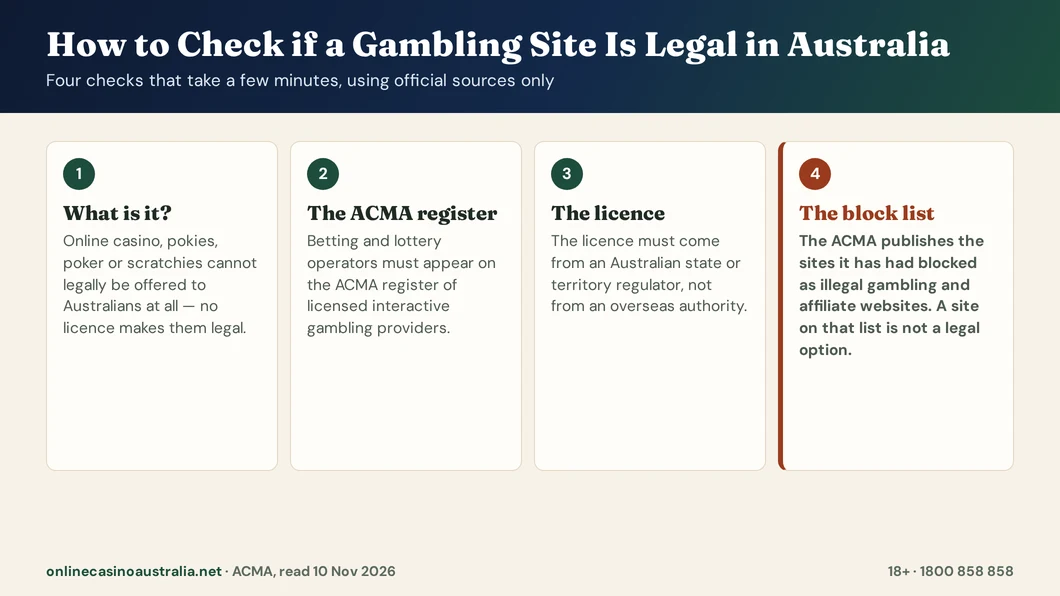
- Look at what it offers. If it is an online casino, online pokies, poker, blackjack, roulette or scratchies, it cannot legally be offered to people in Australia — no licence changes that.
- For betting and lotteries, check the ACMA register. The operator must be listed as a licensed interactive gambling provider.
- Check where the licence comes from. It has to be an Australian state or territory licence, not one issued overseas.
- Check the block list. A site on the ACMA’s list of blocked websites is not a legal option.
What Changes on 1 January 2027
The Interactive Gambling Amendment (Gambling Reform) Act 2026 (No. 72 of 2026) passed both houses of Parliament on 19 August 2026 and received Royal Assent on 26 August 2026. All of its schedules except a transitional one commence on 1 January 2027. The main changes:
| Change | What the Act says | Who it applies to |
|---|---|---|
| Payment blocking (s 15J) | Banks and payment system participants “must prevent, so far as it is reasonably practicable”, payments and transfers — including digital currency — from Australian accounts to designated illegal gambling services | Australian banks (ADIs) and payment systems |
| Blocking by internet services (s 15AB) | Internet service providers, domain name providers, app stores and search engines must prevent their services being used to provide or access illegal gambling services | ISPs, DNS providers, app stores, search engines |
| 24-hour takedown notices | The ACMA can order platforms and hosts to remove illegal gambling ads or stop hosting illegal services, search engines to delete links, and app stores to remove apps | Platforms, hosts, search engines, app stores |
| Online ads count as published in Australia (s 61AB) | An ad for an illegal service on an online content service is taken to be published in Australia if it is available to an end-user in Australia | Anyone publishing online ads |
| Commission ban (s 62ZT) | Licensed wagering providers must not pay staff, agents or affiliates commission linked to customer activity such as sign-ups, deposits or bets | Australian-licensed wagering providers |
| Wagering advertising limits | No wagering ads during live sport coverage from 15 minutes before to 5 minutes after the event between 5am and 8.30pm; no ads in sports venues or on uniforms; no promotion by athletes, celebrities or influencers | Licensed wagering providers and broadcasters |
| Online keno and foreign-matched lotteries | Banned online; keno stays available in licensed venues | Lottery and keno operators |
| Opt-out register and inducements | A national opt-out register for gambling advertising and limits on direct marketing of inducements | Licensed providers |
What the 2027 changes mean for players
For anyone using an offshore casino, payment blocking is the change that matters most. Card payments and bank transfers from Australian accounts to designated illegal services are expected to start failing, and the Act explicitly includes digital currency. Withdrawals usually come back by bank transfer, so the route out of an offshore account is affected as well as the route in. Our guide to casino withdrawals explains how offshore casinos pay out today.
For licensed betting, the changes are mostly about advertising and marketing: fewer ads around live sport, no celebrity endorsements, an opt-out register, and limits on inducements. The rules on what you can legally bet on stay the same.
Rules Already in Force for Licensed Betting
No credit cards or crypto
Since 11 June 2024, online and telephone wagering providers have not been allowed to accept payments by credit card, by funds linked to a credit card (including digital wallets), or in digital currency such as crypto. The ACMA put it simply: “From 11 June 2024, you won’t be able to use a credit card or digital currency to place bets” (ACMA). The ban applies to licensed providers; offshore casinos are outside it, which is one reason they still advertise card and crypto deposits.
BetStop, the national self-exclusion register
BetStop launched on 21 August 2023. It lets you exclude yourself “from all online and phone wagering providers licensed in Australia in one go”, for a minimum of three months up to a lifetime, and you cannot ask to be removed in the first three months. By 30 June 2026, 65,430 people had registered and 40,160 had active exclusions (ACMA). BetStop “does not apply to online casino games or other gambling services that are illegally provided in Australia” — self-excluding from offshore casinos means using each casino’s own tools and blocking software. Our responsible gambling guide explains those options.
Free Casino Games and Social Apps
Casino-style apps played with virtual chips are sold in Australian app stores. Since 22 September 2024, video games with simulated gambling — such as casino-style games — have been classified R 18+ and legally restricted to adults, while games with paid loot boxes are classified at least M (Australian Classification). An R 18+ rating is not a gambling licence: it tells you who the game is for, not that real-money play is allowed.
Do You Pay Tax on Gambling Winnings?
Generally not. The ATO lists “betting and gambling wins (unless you operate a betting or gambling business)” among amounts that are not assessable, and says prizes from ordinary lotteries such as lotto draws and raffles are not declared as income (ATO). The exception is someone who gambles as a business.
How Much Australians Lose on Gambling
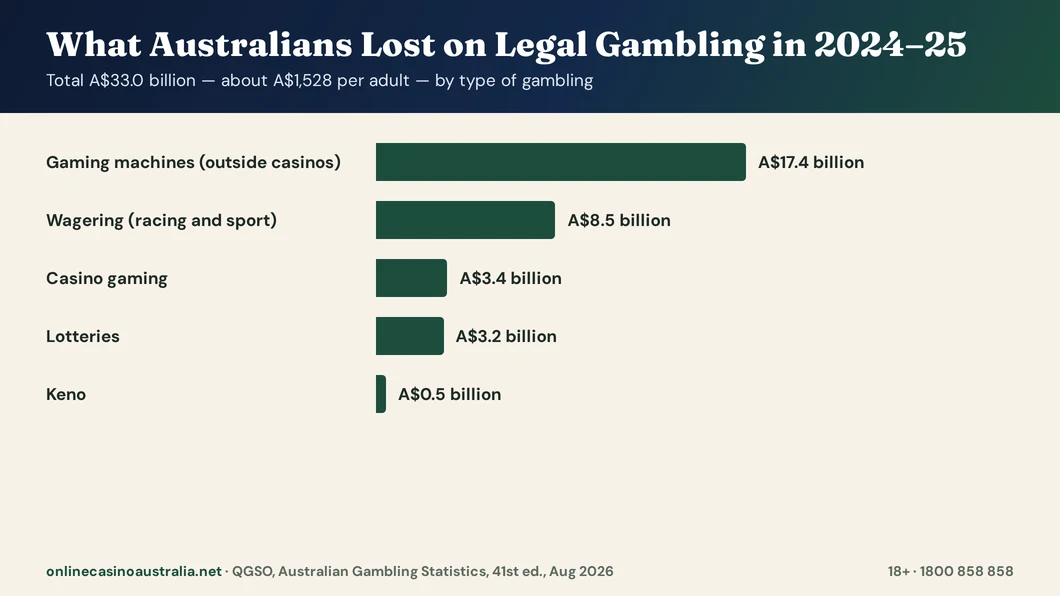
Australians lost A$33.0 billion on legal, regulated gambling in 2024–25 — about A$1,528 per adult — according to the Queensland Government Statistician’s Office (Australian Gambling Statistics, 41st edition, released 11 August 2026). More than half of it went through gaming machines outside casinos.
| Type of gambling | Losses in 2024–25 |
|---|---|
| Gaming machines (outside casinos) | A$17.4 billion |
| Wagering on racing and sport | A$8.5 billion |
| Casino gaming | A$3.4 billion |
| Lotteries | A$3.2 billion |
| Keno | A$0.5 billion |
| Total | A$33.0 billion |
These figures cover legal gambling only. Losses on offshore online casinos are not in the official statistics, because those services are not licensed or reported in Australia.
If You Use an Offshore Casino Anyway
The Act’s offences are aimed at providers and advertisers, not at the customer. But if you use an offshore casino, it is worth being clear about what you give up:
- No Australian regulator. If the casino keeps your money, the ACMA says “Australian regulators will not be able to help you”.
- No BetStop. Self-exclusion has to be done casino by casino.
- Payments get harder from 2027. Banks and payment systems must block transfers to designated illegal services, including crypto.
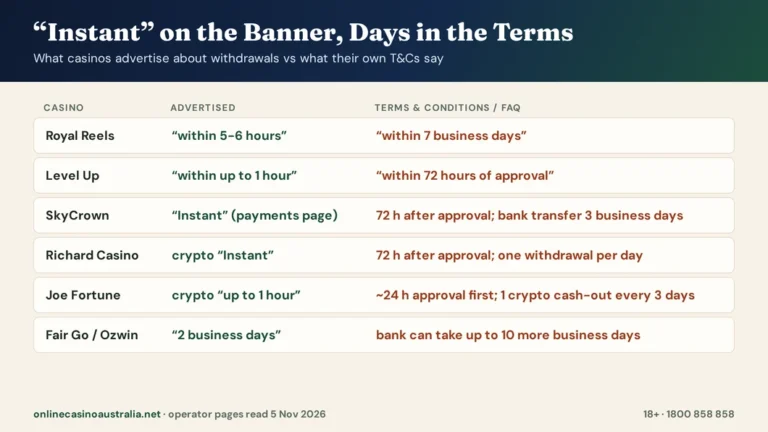
- Terms written offshore. Withdrawal limits, verification rules and bonus conditions are set by the casino, and disputes go to its overseas regulator, if it names one.
If you are weighing this up because gambling has started to cost more than you planned, talk to someone first. The National Gambling Helpline is free, confidential and open 24 hours a day on 1800 858 858, and Gambling Help Online offers chat and email support.
The Bottom Line
Online gambling in Australia is legal in a narrow band: licensed betting on racing and on sport before it starts, and licensed lotteries. Everything casino-style — online pokies, poker, blackjack, roulette, scratchies — cannot legally be offered to Australians, and the ACMA has blocked 1,822 illegal gambling and affiliate sites since 2019. The law targets operators and promoters rather than players, but it leaves players who go offshore without Australian protection, and from 1 January 2027 banks and payment systems must block payments to those services.
How We Put This Guide Together
Every legal statement on this page comes from a primary source read on 10 November 2026: the Interactive Gambling Act 2001 and the Interactive Gambling Amendment (Gambling Reform) Act 2026 on legislation.gov.au; ACMA pages on the Act, illegal operators, blocking, the register of licensed providers, investigations, the credit card ban and BetStop; the Minister for Communications’ media release of 19 August 2026; the Department of Social Services; the ATO; Australian Classification; and the Queensland Government Statistician’s Office. Quotes are reproduced as published. This guide explains the law in general terms and is not legal advice. Written by Michael Jones — see how we review. 18+ only. If gambling stops being fun, call 1800 858 858.