


Can You Win on the Pokies? The Short Answer
Not over time. Every Australian pokie is required by law to pay back less than it takes — at least 85% to 90% of all money bet, depending on the state, measured over millions of games — and every spin is decided at random the moment you press the button. You can win on a given night; nobody can beat the machine in the long run, and no tip, timing or system changes that.
This page explains how pokies work, what the return-to-player percentage really means, the legal minimums in each state, what an hour of play costs on average, why the “near miss” and the celebrated small win feel the way they do, and the myths that keep people playing. Every rule comes from the regulators and the national technical standard for gaming machines.
How a Pokie Decides Each Spin
Inside every pokie is a computer program called a random number generator. NSW’s GambleAware explains that it “creates thousands of possible results every second”; when you press the button, the machine takes the result of that instant and maps it to positions on the reels and a pay table (Australian Gambling Research Centre).
The national technical standard that every Australian machine must meet requires results to be statistically independent, uniformly distributed and unpredictable, and each simulated reel to be independent of the others and of its own previous behaviour (Gaming Machine National Standard). In plain words: the machine has no memory.
Decided the moment you press the button
GambleAware NSW puts it simply: “Outcomes are determined the moment you press the play button.” You cannot influence the result by changing your bet, stopping the reels, timing your play or using any strategy (GambleAware NSW). Victoria’s regulator adds that “there is no pattern, cycle or ‘due win’” (VGCCC).
Millions of possible outcomes
Most pokie games have 50 million or more possible outcomes. One classic game analysed by the Australian Gambling Research Centre, Dolphin Treasure, has 35,640,000 — which would take at least 5.6 years of non-stop play at one spin every five seconds just to cycle through once (AIFS). That is why a machine’s advertised return only shows up over a very long time.
What “Return to Player” Really Means
Return to player (RTP) is the share of all money bet that a machine pays back as prizes over its whole cycle of outcomes. The rest is the venue’s margin. Australian pokies must display this warning on their game-information screen: “It may take millions of games for a gaming machine to tend towards its ‘return to players’ setting. An individual gaming machine will not return a minimum value of prizes in any given period of play.”
85% does not mean 85 cents back each time
GambleAware NSW is explicit: machines are required to return 85–92% of all money bet over their lifetime, and that “does not mean you get back 85–92 cents for every dollar you bet”. Gambling Help Queensland notes that an 85% return is achieved over the life of the machine, usually three to four years (Gambling Help Qld).
Why you lose more than the margin
The margin is taken from every spin, including spins paid for with your winnings. In 2024–25, Australians bet A$219.7 billion through pub and club pokies in the six jurisdictions that report turnover and lost A$17.3 billion of it. By our calculation the machines paid back about 92 cents in every dollar bet — and the losses still added up, because winnings are usually played back in (QGSO).
The Legal Minimum in Each State
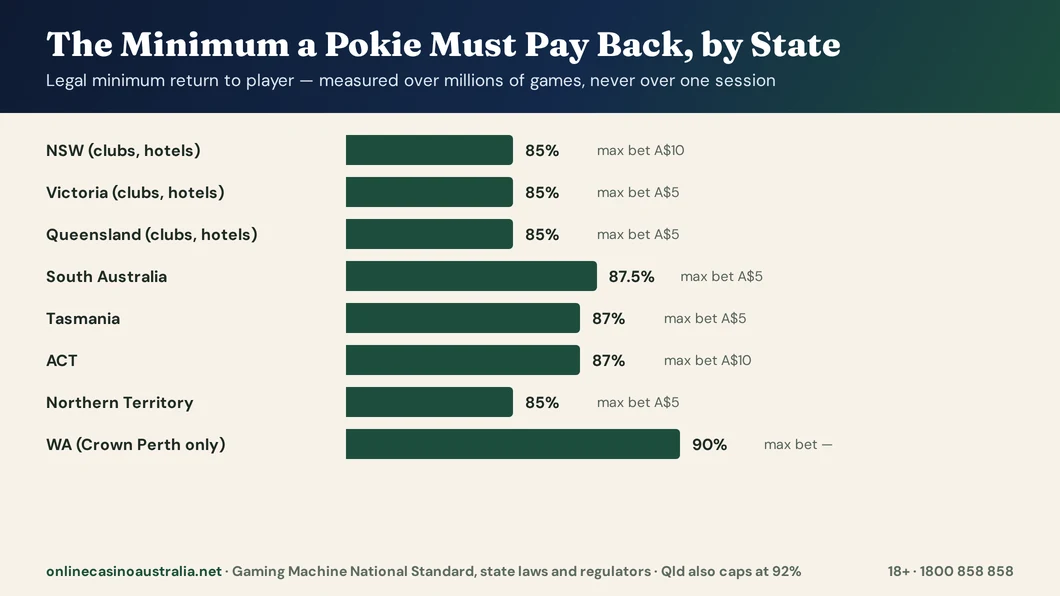
| State or territory | Minimum return to player | Maximum bet per spin (clubs and hotels) |
|---|---|---|
| New South Wales | 85% (clubs and hotels) | A$10 |
| Victoria | 85% per venue per year (Crown Melbourne: 87%) | A$5 |
| Queensland | 85% to 92% in clubs and hotels; 85% in casinos | A$5 |
| South Australia | 87.5% for new machines | A$5 |
| Tasmania | 87% | A$5 |
| Australian Capital Territory | 87% | A$10 |
| Northern Territory | 85% per machine per year | A$5 |
| Western Australia | No poker machines; Crown Perth’s electronic machines at least 90% | — |
Sources: the Gaming Machine National Standard (NSW, Queensland, ACT and Crown Melbourne figures and bet limits), Victoria’s Gambling Regulation Act 2003, South Australia’s Gambling Harm Support, Tasmania’s gaming machine standards of July 2026, the Northern Territory Gaming Machine Regulations and Western Australia’s RTP policy. Queensland is the only state that also caps the return, at 92%, and venues there can change a game’s setting only once a month within that range.
What an Hour of Play Costs
Because the margin applies to every spin, the cost of play depends on three numbers: the bet, the number of spins and the RTP. Victoria now requires newly approved game types to take at least three seconds per spin — about 1,200 spins an hour. The table shows the average loss over an hour at that pace. These are our calculations; a single hour can be far better or far worse.
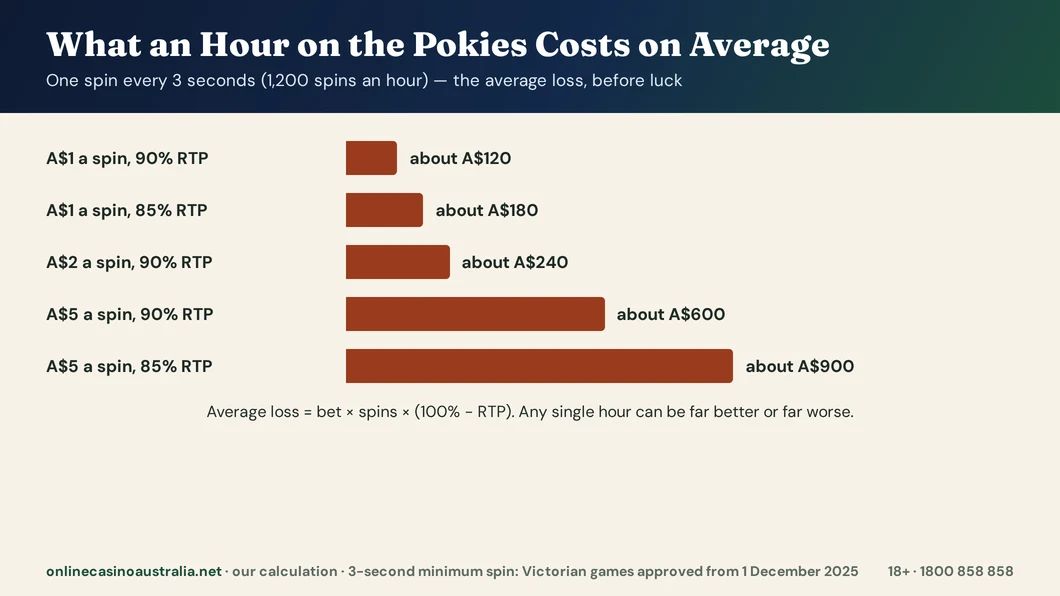
| Bet per spin | RTP | Spins per hour | Amount bet | Average loss |
|---|---|---|---|---|
| A$1 | 90% | 1,200 | A$1,200 | about A$120 |
| A$1 | 85% | 1,200 | A$1,200 | about A$180 |
| A$2 | 90% | 1,200 | A$2,400 | about A$240 |
| A$5 | 90% | 1,200 | A$6,000 | about A$600 |
| A$5 | 85% | 1,200 | A$6,000 | about A$900 |
The Productivity Commission found in 2010 that even a “one cent” pokie played at maximum intensity can take bets of up to A$12,000 an hour, for average losses of about A$1,200 an hour (Productivity Commission). On a one-cent machine in Queensland, Gambling Help Qld notes that 20 games a minute at 10 lines and 10 credits a line is A$20 a minute.
How Big Prizes Really Work
Big prizes are possible and very rare. GambleAware NSW puts the odds of winning a typical A$5,000 prize on a A$1 machine at 9.7 million to 1. Applying the Productivity Commission’s method to Dolphin Treasure, a player would need 24.7 million spins for a 50% chance of the top prize — at 40 cents a spin every five seconds, nearly A$1.2 million and 3.9 years of non-stop play.
The occasional big win that someone in the venue lands does not change your odds. It is paid for by the margin on everyone’s spins, and the next spin starts from the same odds as the last.
Near Misses and Losses Disguised as Wins
Losses disguised as wins
On a multi-line machine, a “win” is often a loss. If you bet 1 cent on each of 50 lines and one line pays 5 cents, the machine celebrates with lights and sounds — though you have just lost 45 cents on that spin (Australian Gambling Research Centre). Researchers at the University of Waterloo who coined the term found that these celebrated losses excite players much like real wins, and that with 20 lines bet the majority of “hits” are losses disguised as wins.
Near misses
A University of Cambridge brain-imaging study found that near misses were experienced as less pleasant than full misses yet increased the desire to play, and activated the same reward circuitry as real wins. Australia’s technical standard forbids machines from being programmed to create a misleading frequency of near misses — but game maths makes them common anyway: in Dolphin Treasure, top symbols are scarcer on the first reels, so seeing them on the later reels is far more frequent than lining them all up.
Myths About Pokies
| Myth | What the regulators say |
|---|---|
| A machine is “due” to pay after a long run of losses | No machine is due to pay; your chance is the same on every play (Gambling Help Qld) |
| A machine that just paid a big win won’t pay again for a while | Past wins and losses have nothing to do with the next payout (Gambling Help Qld) |
| Some machines are “hot” | Pokies don’t keep track of results; each play is drawn independently (Gambling Help Qld) |
| Changing your bet size can trick the machine | Each spin is independent and the machine does not remember the last game (Gambling Help Qld) |
| There is a best time of day to play | Time of day, bet size, streaks or how you press the button make no difference (Gambling Help Qld) |
| A near miss means a win is close | Symbols are displayed at random and say nothing about the next spin (Gambling Help Qld) |
| Pokies are rigged | They are tested and regulated for fairness — but designed to make money for the venue, so the odds of winning big are extremely low (VGCCC) |
| There is a strategy that improves your chances | No strategy or technique can improve your chances in a game of chance (Gambling Help Online) |
Sources: Gambling Help Queensland — Facts and myths, VGCCC — Understanding poker machines and Gambling Help Online — How do pokies work.
Online Pokies Are a Different Game
Online pokies cannot legally be offered to people in Australia: the ACMA lists online slots among illegal online services. The ones offered by offshore casinos are not covered by any of the state minimums above. Their RTP is set by the game studio — and many studios sell the same game in several versions. Quickspin says its Cash Truck Begins comes “with 4 RTP versions, namely 96%, 94%, 92% and 84%”; Hacksaw Gaming publishes four versions of Wanted Dead or a Wild, from 96.38% down to 88.42%. By our calculation, the lowest version of that game costs about three times as much per spin as the highest.
Our online pokies guide explains RTP and volatility in more detail, and our guide to whether online gambling is legal in Australia covers the law.
Who Pokies Hurt Most
The Productivity Commission found that around 600,000 Australians played the pokies at least weekly, that about 15% of these regular players were problem gamblers, and that problem gamblers accounted for around 40% of all gaming machine spending. In NSW, poker machines account for 54.8% of all gambling harm, and 18.5% of people who use them experience moderate- or high-risk gambling, compared with 5.8% of all gamblers (NSW Gambling Survey 2024). Among NSW pokie players, moderate- or high-risk gambling rises with session length: 25.4% for usual sessions of one to two hours and 61.1% for three hours or more.
If You Play, Play on Purpose
- Decide what you will spend before you sit down, and treat it as the price of the entertainment, not money you expect back.
- Set a time limit: harm rises sharply with session length.
- Never reinvest a win you meant to keep; cash it out.
- Use the venue’s tools where they exist — pre-set limits, breaks and self-exclusion.
- If you are chasing losses or playing to win back money, stop and talk to someone.
Free, confidential support is available 24 hours a day on 1800 858 858 and at Gambling Help Online. Our responsible gambling guide covers limits, blocking tools and self-exclusion.
The Bottom Line
A pokie is a machine built to pay back less than it takes: by law at least 85% to 90% of all money bet, over millions of games, with every spin decided at random. There is no way to win over time, no machine that is due, and no tip that helps. What you can control is how much you bet, for how long, and when you stop.
How We Put This Guide Together
Every rule on this page comes from a primary source read on 10 November 2026: the Gaming Machine National Standard (revision 12.1), state legislation and regulators (GambleAware NSW, the VGCCC, Gambling Help Queensland, South Australia’s Gambling Harm Support, Tasmania’s gaming standards, the Northern Territory regulations, Western Australia’s RTP policy), the Australian Gambling Research Centre, the Productivity Commission’s 2010 report, the NSW Gambling Survey 2024 and the Queensland Government Statistician’s Office. The cost-per-hour figures and the payback calculation are our own. Written by Michael Jones — see how we review. 18+ only. If gambling stops being fun, call 1800 858 858.