


Online Poker in Australia: The Short Answer
Real-money online poker cannot legally be offered to people in Australia. The Interactive Gambling Act 2001 prohibits it, the big international poker sites closed their Australian accounts in September 2017, and in July 2026 the Federal Court ordered A$24.24 million in penalties against the providers and promoters of three online poker services that had kept going. Poker itself is far from banned, though. Australians play it legally every night in three places:
- Casino poker rooms — real money, real cards, and the country’s biggest tournaments. The Aussie Millions returned to Crown Melbourne in 2026 with a A$7.7 million Main Event prize pool.
- Pub and club leagues — the Australian Poker League runs more than 600 events a week in licensed venues, leading up to the APL Million.
- Social poker apps — WSOP Poker and Zynga Poker, played with virtual chips that cannot be cashed out, restricted to adults.
This guide explains where the legal line sits and why, then covers what you need to sit down at a table: the rules of Texas Hold’em, hand rankings, the odds behind the most common decisions — which we calculated ourselves — how tournaments work, and the table rules that catch out first-timers in a live room.
Is Online Poker Legal in Australia?
What the Interactive Gambling Act prohibits
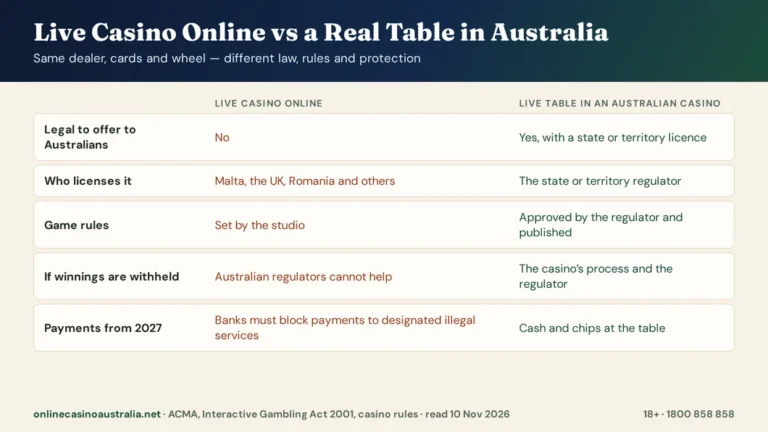
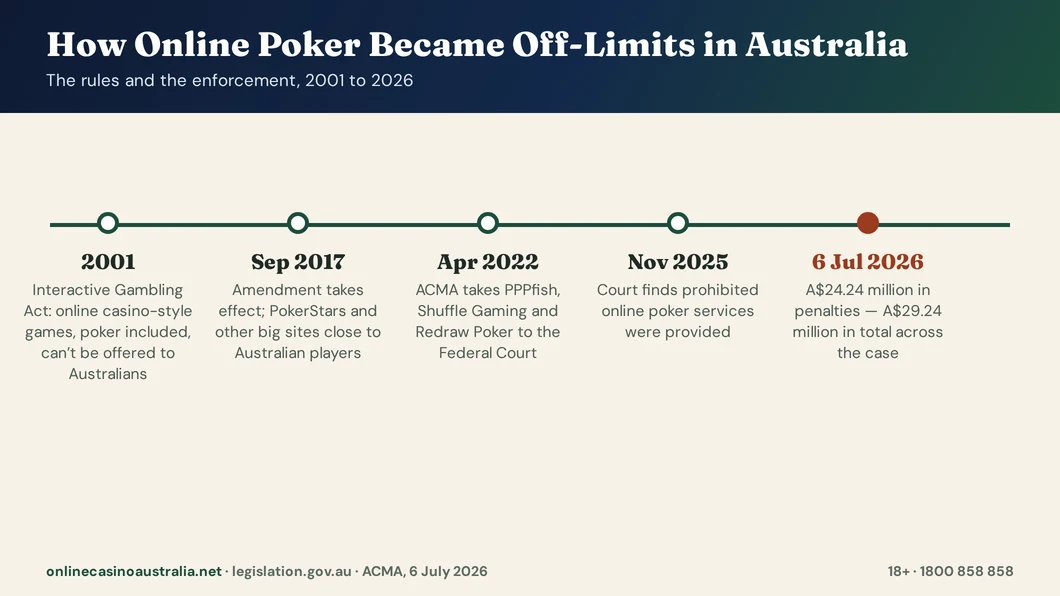
The Interactive Gambling Act 2001 (IGA) makes it an offence to provide certain “interactive gambling services” to customers in Australia. Online casino-style games played for money — pokies, roulette, blackjack and poker among them — fall into the prohibited group. Only some forms of online gambling can be licensed here: sports and race wagering through state and territory licences, and lotteries. There is no Australian licence that permits online casino games or online poker for real money.
What happened in September 2017
For years, offshore poker sites argued that poker sat in a grey area. An amendment to the Act, which took effect in September 2017, removed the doubt and strengthened enforcement against offshore operators. PokerStars and the other large international poker sites closed real-money play to Australian accounts around that date. Since then, every real-money online poker service offered to Australians has been operating outside the law.
Are players breaking the law?
The IGA targets the people who provide and promote prohibited services, not the individuals who use them. That does not make playing safe. If an offshore poker site freezes your balance, refuses a withdrawal or simply disappears, no Australian regulator can help you get your money back, and there is no local dispute service to complain to. Our guide to whether online gambling is legal in Australia sets out the rest of the Act, the penalties and the changes that start in 2027.
The A$24 million online poker case
The clearest signal of how seriously the law is enforced came on 6 July 2026. The Australian Communications and Media Authority (ACMA) announced that the Federal Court had ordered A$24.24 million in penalties against the providers and promoters of three online poker services: PPPfish, Shuffle Gaming and Redraw Poker.
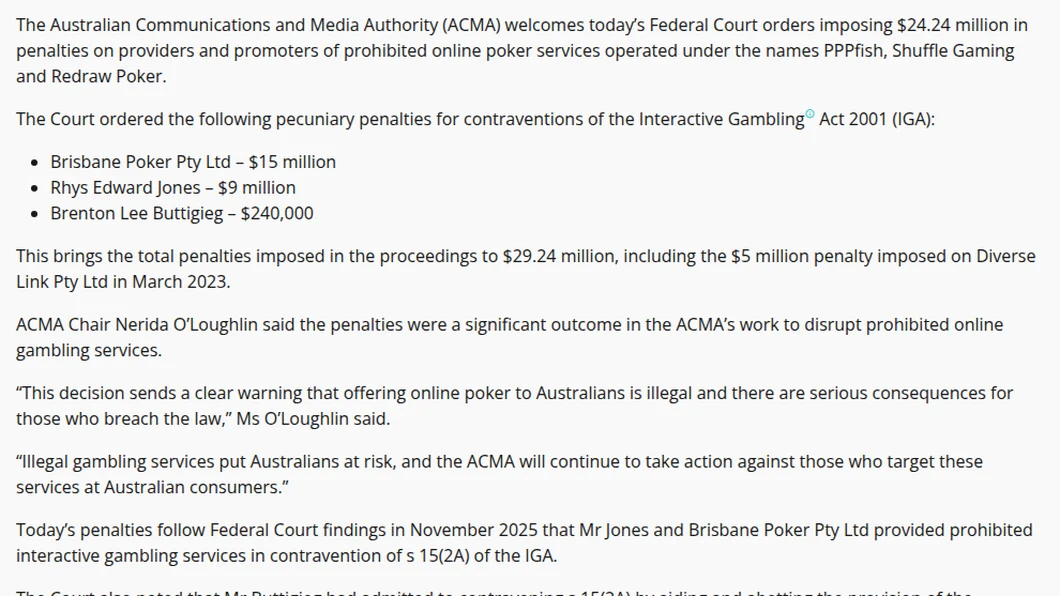
| Who | Penalty | Context |
|---|---|---|
| Brisbane Poker Pty Ltd | A$15,000,000 | Found in November 2025 to have provided prohibited interactive gambling services (s 15(2A) of the IGA) |
| Rhys Edward Jones | A$9,000,000 | Same findings; restrained from providing a prohibited service for 5 years |
| Brenton Lee Buttigieg | A$240,000 | Admitted aiding and abetting; restrained for 5 years |
| Diverse Link Pty Ltd | A$5,000,000 | Penalty imposed in March 2023 in the same proceedings |
| Total in the proceedings | A$29,240,000 | Case commenced by the ACMA in April 2022 |
ACMA Chair Nerida O’Loughlin put it plainly: “This decision sends a clear warning that offering online poker to Australians is illegal and there are serious consequences for those who breach the law.”
Why “virtual chips” did not make it legal
The detail that matters most for players is how these services worked. According to the ACMA, the Court found they “allowed members of the public to play online poker against other players using virtual chips that could be purchased and sold for real money.” In other words, calling the currency “chips” or “points” changes nothing if those chips can be bought with money and turned back into money. That is the test to apply to any poker app or “club” that promises free play with a way to cash out.
What changes for payments from 2027
Under the Interactive Gambling Amendment (Gambling Reform) Act 2026, Australian banks and payment providers must take steps to block transfers to designated illegal gambling services from 1 January 2027. Deposits to and withdrawals from offshore poker sites through Australian bank accounts are expected to become harder. Our guide to fast withdrawals at offshore casinos explains the payment side in more detail.
Where Australians Can Play Poker Legally
Take real-money online poker off the table and three legal options remain. They suit different players: the casino room for real stakes, the pub league for regular low-cost tournaments, and apps for practice.
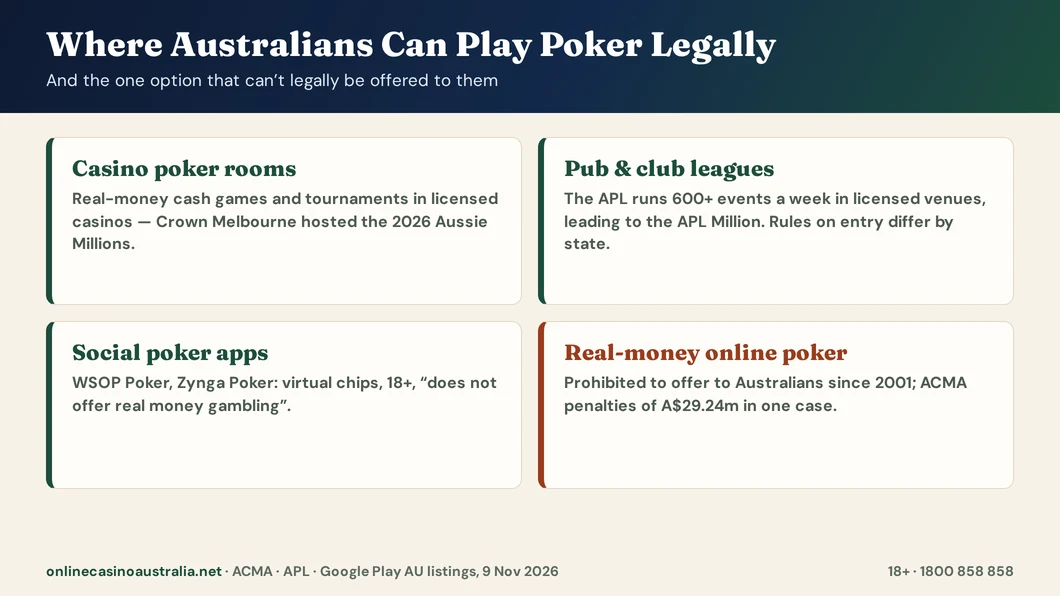
| Option | Real money? | Who runs it | Best for |
|---|---|---|---|
| Casino poker room | Yes — cash games and tournaments | Licensed casinos such as Crown Melbourne | Real stakes, major tournaments |
| Pub and club league | Varies by state; many weekly games free to enter | Australian Poker League and venues | Regular tournaments close to home |
| Social poker app | No — virtual chips only | App publishers (Playtika, Zynga) | Learning, practice, casual play |
| Real-money online poker | Yes | Offshore operators only | Prohibited to offer to Australians |
Casino poker rooms
Licensed casinos are the only place in Australia to play poker for real money against other players. Crown Melbourne is the centre of the tournament scene: its licence includes up to 100 poker tables, and it hosted the 2026 Aussie Millions from 24 April to 10 May in a new poker room. Crown Perth and The Star Sydney also run poker rooms. Games, limits and opening hours change, so check the casino’s own page before you go.
Pub and club poker leagues
The Australian Poker League (APL) has run poker tournaments in pubs, clubs and hotels since 2005 and describes itself as Australia’s largest in-venue poker operator, with more than 600 events a week nationally. Players register, collect points across weekly games and qualify through venue and state events. The season builds to the APL Million: the 2026 series at Southport Sharks on the Gold Coast had 100 events, A$17,217,160 in total prize pools and a A$3 million guaranteed Main Event. Rules on entry fees and prizes differ between states, and the APL says venues are set up to meet their state’s requirements.
Social poker apps
Free-to-play poker apps let you play Texas Hold’em against real people with virtual chips. The two biggest on Google Play in Australia, WSOP Poker and Zynga Poker, both state that they are “intended for an adult audience” and do “not offer real money gambling or an opportunity to win real money or prizes”. Both are listed as restricted to 18+, in line with the Australian classification rules that since 22 September 2024 give games with simulated gambling a minimum R 18+ rating. Chips can be bought, but they cannot be won back as money — whatever you spend is spent.
Home games
Private games among friends are regulated by the states and territories, not by the IGA, and the rules differ from one to the next — including whether the host can take a cut. If you run a regular game, check your state’s gaming regulator before money changes hands.
Social Poker Apps vs Real-Money Online Poker
The line between a legal app and an illegal poker site is not the software, the table design or the word used for chips. It is whether money can come back out.
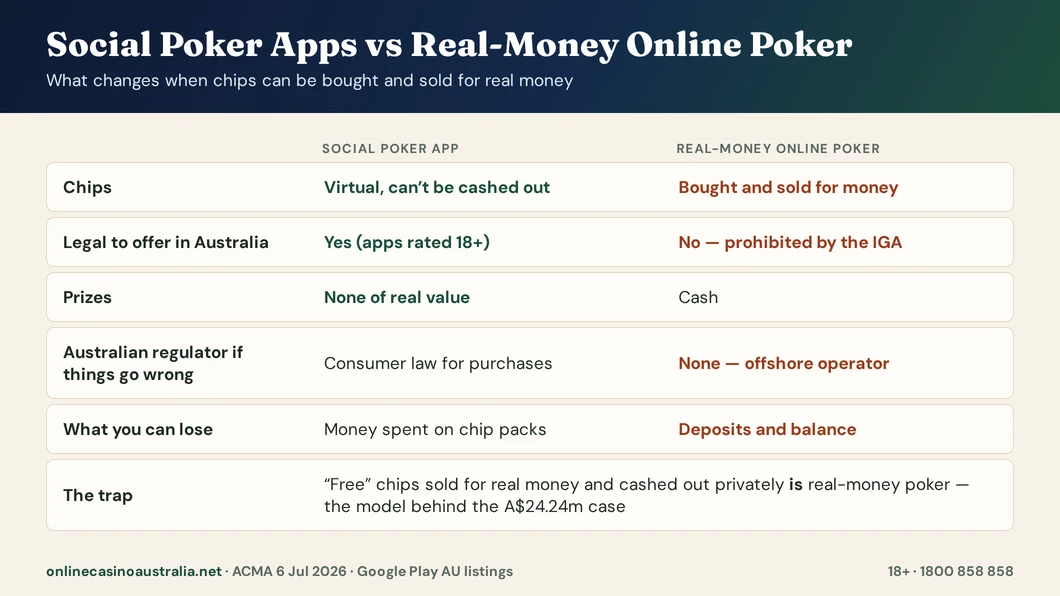
| Question | Social poker app | Real-money online poker |
|---|---|---|
| Can chips be cashed out? | No | Yes |
| Legal to offer to Australians? | Yes, as a game rated 18+ | No — prohibited by the IGA |
| Prizes of real value? | None | Cash |
| Age limit | 18+ (simulated gambling) | 18+ (and offshore) |
| Australian help if something goes wrong | Consumer law for in-app purchases | None — offshore operator |
| What you can lose | Money spent on chip packs | Deposits and any balance |
How to spot a disguised real-money poker service
- Chips or “points” that can be sold back, swapped with an “agent” or settled in cash or crypto outside the app.
- Private “clubs” or “unions” inside an app, where a host collects and pays out money through bank transfers.
- Invitations that come through social media or messaging groups rather than an app store.
- Promises of real-money poker “for Australians”, which no operator can legally offer.
This is precisely the structure the Federal Court looked at in the PPPfish, Shuffle Gaming and Redraw Poker case. If you are being asked to transfer money to a person to get chips, it is real-money gambling with none of the protections.
How Texas Hold’em Works
Texas Hold’em is the game played in almost every Australian poker room, pub league and app. The rules fit on a page; the skill is in the decisions.
The button and the blinds
A disc called the button marks the nominal dealer and moves one seat clockwise after each hand. The two players to its left post forced bets before the cards are dealt: the small blind and the big blind (usually twice the small blind). The blinds create a pot to play for and make sure every hand has something at stake.
The four betting rounds
| Round | Cards | Who acts first |
|---|---|---|
| Pre-flop | Each player gets two private cards (hole cards) | Player to the left of the big blind |
| Flop | Three shared cards dealt face up | First active player to the left of the button |
| Turn | A fourth shared card | Same order |
| River | A fifth and final shared card | Same order, then showdown |
Your options on each turn
- Check — pass the action without betting, only if no one has bet in this round.
- Bet — put chips in when no one has bet yet.
- Call — match the current bet.
- Raise — increase the bet; others must call the new amount, re-raise or fold.
- Fold — give up the hand and any chips already in the pot.
The showdown: best five cards out of seven
If more than one player is left after the river betting, cards are turned over. Each player makes the best possible five-card hand from their two hole cards and the five community cards, using any combination — both hole cards, one, or none (“playing the board”). The best hand wins the pot; equal hands split it.
No-limit, pot-limit and fixed-limit
The betting structure changes the game more than most beginners expect. In no-limit, the standard in tournaments, you can bet all your chips at any time. In pot-limit, the maximum bet is the size of the pot. In fixed-limit, bets and raises come in set amounts. The same hand can be a clear raise in one structure and a fold in another.
Omaha and other variants
Pot-Limit Omaha is the second most common game in live rooms. Each player receives four hole cards and must use exactly two of them with exactly three community cards. That single rule catches out more Hold’em players than anything else: four hearts in your hand and one on the board is not a flush in Omaha.
Why position matters
The player who acts last in a betting round has seen what everyone else did before deciding. That is a real advantage, and it is why the button is the best seat at the table and the blinds are the worst after the flop. Most experienced players play more hands from late position and fewer from early position, where several opponents still have to act behind them.
Starting hands for beginners
There is no single correct list, but beginners lose most of their money by playing weak hands from bad positions. A simple, conservative starting point:
| Position | Hands worth playing | Why |
|---|---|---|
| Early (first to act) | Big pairs (A-A to 10-10), A-K, A-Q | Many players still to act; you need hands that stand up to raises |
| Middle | Add 9-9 to 7-7, A-J, K-Q, suited aces | Fewer players behind you |
| Late (cut-off, button) | Add small pairs, suited connectors (e.g. 8-7 suited), more broadway hands | You act last after the flop |
| Blinds | Defend selectively against late-position raises | You are out of position for every later round |
As you gain experience you will widen these ranges. Until then, folding marginal hands from early position is the single cheapest improvement you can make.
A hand played out, step by step
To see how the rules, position and odds fit together, follow one hand at a small casino cash game with A$1 and A$2 blinds. You are on the button with 8♥ 7♥. Two players fold, a player in middle position raises to A$6, and you call, because suited connectors play well in position. Both blinds fold. The pot is A$15.
The flop comes K♥ 6♥ 2♣. You have a flush draw: nine hearts left among 47 unseen cards. Your opponent bets A$10. You must pay A$10 to win A$35, a price of about 29%, and your chance of making the flush by the river is 35% — but if you only look one card ahead, the turn alone gives you 19.1%. Because you are last to act and can expect to win more when the flush comes, calling is reasonable. The pot is now A$35.
The turn is the 3♠, no help. Your opponent bets A$25 into A$35. Now there is one card left: 9 outs from 46 cards, 19.6%. You must pay A$25 to win A$85, which is 29%. The pot odds no longer justify the call, so you fold. Over many hands, decisions like this one — folding when the price is wrong — matter more than the occasional big pot.
Poker Hand Rankings
Every form of poker in this guide uses the same ranking of five-card hands. The rarer the hand, the higher it ranks. We calculated the odds of being dealt each hand from all 2,598,960 possible five-card combinations; the last column shows how often each hand ends up as a player’s best hand from seven cards in Hold’em.
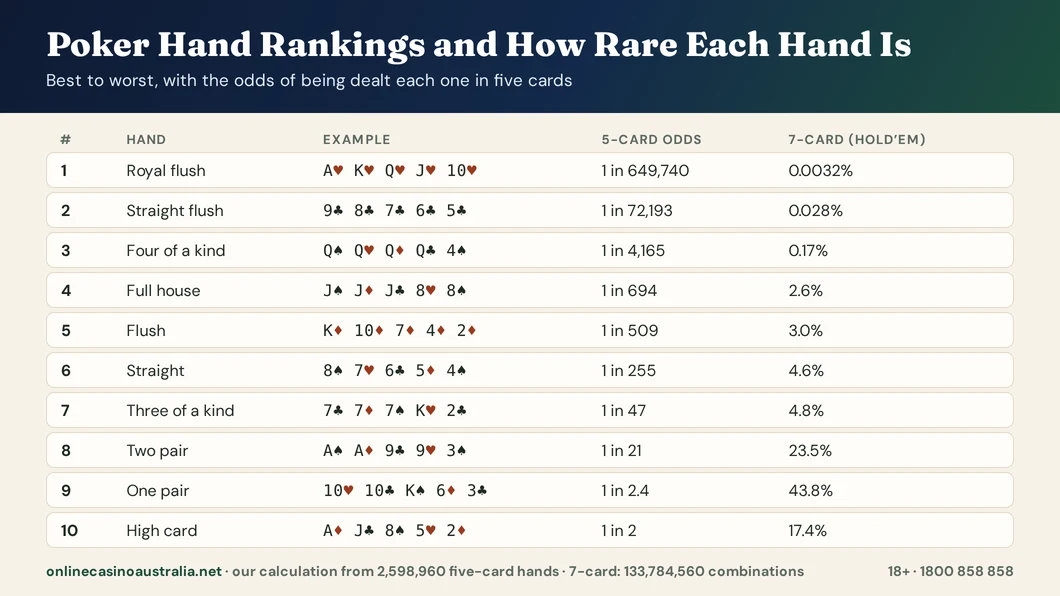
| Rank | Hand | Combinations (5 cards) | Probability | Odds |
|---|---|---|---|---|
| 1 | Royal flush | 4 | 0.0002% | 1 in 649,740 |
| 2 | Straight flush | 36 | 0.0014% | 1 in 72,193 |
| 3 | Four of a kind | 624 | 0.024% | 1 in 4,165 |
| 4 | Full house | 3,744 | 0.144% | 1 in 694 |
| 5 | Flush | 5,108 | 0.197% | 1 in 509 |
| 6 | Straight | 10,200 | 0.39% | 1 in 255 |
| 7 | Three of a kind | 54,912 | 2.11% | 1 in 47 |
| 8 | Two pair | 123,552 | 4.75% | 1 in 21 |
| 9 | One pair | 1,098,240 | 42.3% | 1 in 2.4 |
| 10 | High card | 1,302,540 | 50.1% | 1 in 2 |
Ties and kickers
When two players hold the same type of hand, the higher cards decide it. Two players with a pair of kings compare their next-highest cards, called kickers, one by one. If all five cards match in rank, the pot is split — suits never break ties in Hold’em.
Ranking mistakes that cost pots
- A flush beats a straight, and a full house beats a flush.
- The ace can be high (A-K-Q-J-10) or low (5-4-3-2-A, “the wheel”), but straights do not wrap around: Q-K-A-2-3 is not a straight.
- Two pair is judged by the higher pair first: kings and threes beat queens and jacks.
- Only five cards count. A sixth or seventh card never plays, however good it looks.
The Odds Every Hold’em Player Should Know
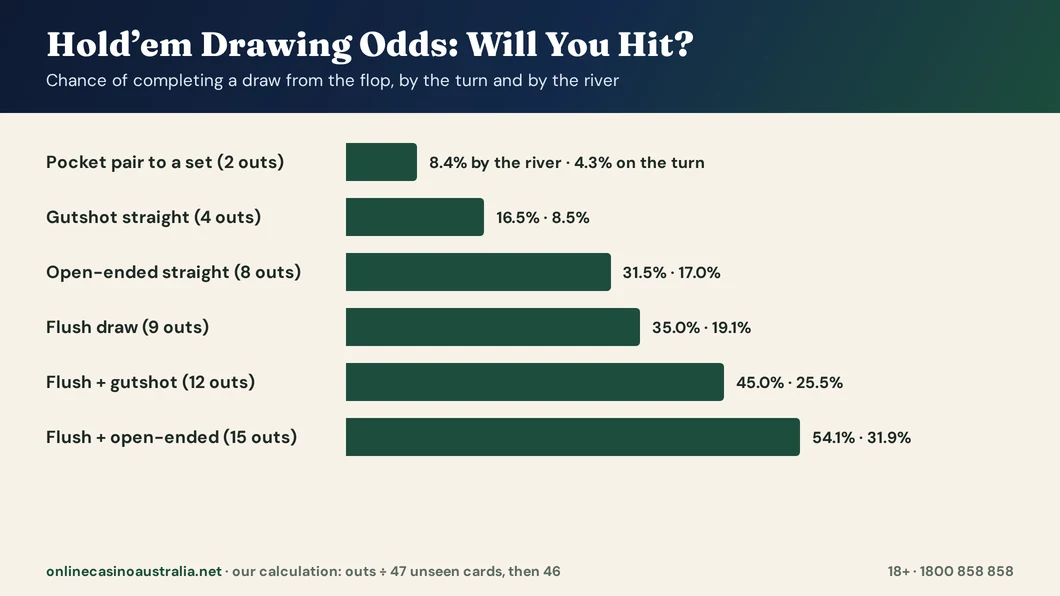
Poker is a game of incomplete information, but the maths of the deck is fixed. A handful of numbers covers most decisions on the flop and turn. All the figures below are our own calculations from the 47 cards you cannot see after the flop.
Counting your outs
An “out” is a card that improves your hand to what you think is the winner. With four cards to a flush after the flop, nine cards of that suit are left, so you have nine outs. With an open-ended straight draw (for example 9-8 on a 7-6-2 board), any five or ten completes it: eight outs.
| Draw after the flop | Outs | Hit on the turn | Hit by the river | Rule of 4 estimate |
|---|---|---|---|---|
| Pocket pair to three of a kind | 2 | 4.3% | 8.4% | 8% |
| Gutshot straight draw | 4 | 8.5% | 16.5% | 16% |
| Open-ended straight draw | 8 | 17.0% | 31.5% | 32% |
| Flush draw | 9 | 19.1% | 35.0% | 36% |
| Flush draw + gutshot | 12 | 25.5% | 45.0% | 48% |
| Flush draw + open-ended straight | 15 | 31.9% | 54.1% | 60% |
The rule of 4 and 2
At the table there is no time for exact maths. Multiply your outs by 4 on the flop to estimate your chance of hitting by the river, or by 2 on the turn for one card to come. As the table shows, the shortcut is close for small draws and overestimates big ones: with 15 outs the real figure is 54%, not 60%.
Pot odds: a worked example
You hold a flush draw on the turn. The pot is A$90 and your opponent bets A$30, so you must pay A$30 to win A$120 — a price of 25%. One card is left and your nine outs give you a 19.6% chance (9 out of 46). Because 19.6% is lower than the 25% you are being asked to pay, calling loses money in the long run, unless you expect to win extra when you hit. Change the bet to A$15 and the price drops to 14%; now the call is profitable.
Starting-hand facts
| Event | Probability | Roughly |
|---|---|---|
| Being dealt any pocket pair | 5.9% | 1 hand in 17 |
| Being dealt pocket aces | 0.45% | 1 hand in 221 |
| Flopping three of a kind with a pocket pair | 11.8% | 1 time in 8.5 |
| Making a flush by the river with a flush draw on the flop | 35.0% | about 1 in 3 |
The pocket-pair number explains a lot about tournament poker: you will wait a long time for aces, and when you have a small pair, you will miss the flop seven times out of eight.
Cash Games vs Tournaments
Live rooms and leagues offer two formats that feel like different games.
| Cash game | Tournament | |
|---|---|---|
| Chips | Worth their face value in money | Have no cash value; only finishing position pays |
| Buy-in | Choose your amount within table limits | Fixed entry fee for everyone |
| Leaving | Any time, cash out your chips | When you are knocked out or the event ends |
| Blinds | Stay the same | Rise on a clock |
| House income | Rake taken from pots or a time charge | Fee built into the entry |
| Variance | Lower per session | High — a long event can end in one hand |
Pub leagues are tournaments. Casino rooms run both. If you are new, a low buy-in tournament is the most predictable way to play: you know in advance exactly how much it can cost.
How a Poker Tournament Works
Starting stacks and blind levels
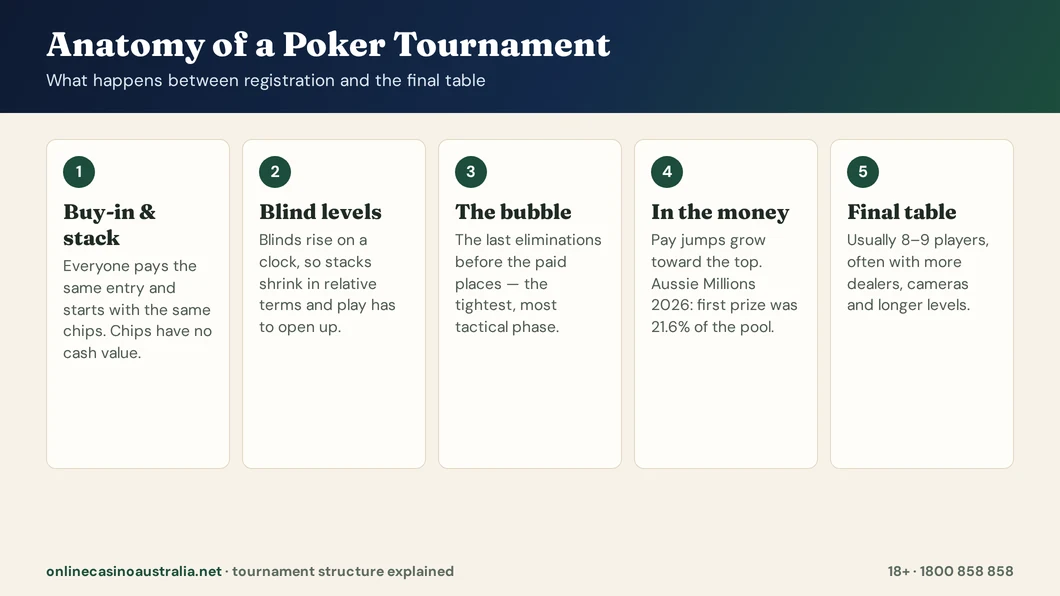
Every player starts with the same number of chips. Blinds increase at set intervals — every 20 or 30 minutes in a typical live event, much longer in major championships. As blinds rise, stacks become smaller relative to the cost of each orbit, which forces players to take risks. Managing your stack against the blinds is the central tournament skill.
The bubble
The bubble is the point just before the paid places, when one more elimination means everyone left wins money. Play typically tightens; players with big stacks can put pressure on those who are just hanging on.
How the prize pool is shared
Payouts climb steeply toward the top. At the 2026 Aussie Millions Main Event, 770 entries created a A$7.7 million prize pool, and the winner, Malcolm Trayner, took A$1,667,050 — 21.6% of the entire pool, in a field where most players won nothing.
Re-entries and late registration
Many events allow late registration during the early levels and, in “re-entry” events, a new buy-in after you bust. Both increase the prize pool and your total cost. Decide your maximum number of entries before you start, not after a bad beat.
Tournament formats you will see on a schedule
| Format | How it works | What it means for your cost |
|---|---|---|
| Freezeout | One entry per player; when your chips are gone, you are out | Your maximum cost is the single buy-in |
| Re-entry | You can buy in again after busting, during the late-registration period | Total cost can be several buy-ins |
| Bounty / knockout | Part of each buy-in is placed on players’ heads; you win it by eliminating them | Prize money is paid out during the event, not only at the end |
| Satellite | The prize is a seat in a bigger event rather than cash | A cheaper route into a major tournament |
| Turbo | Blind levels rise faster than usual | Shorter event, more luck involved |
Satellites and qualifiers
Satellites are the reason players with modest bankrolls end up at big events. A satellite with a lower buy-in awards seats in a larger tournament to its top finishers. The pub league model works in a similar way: weekly games feed into venue and state events, which feed into the APL Million. If you are aiming for a major series, a satellite or qualifier is usually a better use of a budget than a direct buy-in you cannot comfortably afford.
The Australian Live Poker Calendar
Live poker in Australia is built around a few big series, with pub league finals and casino festivals in between.
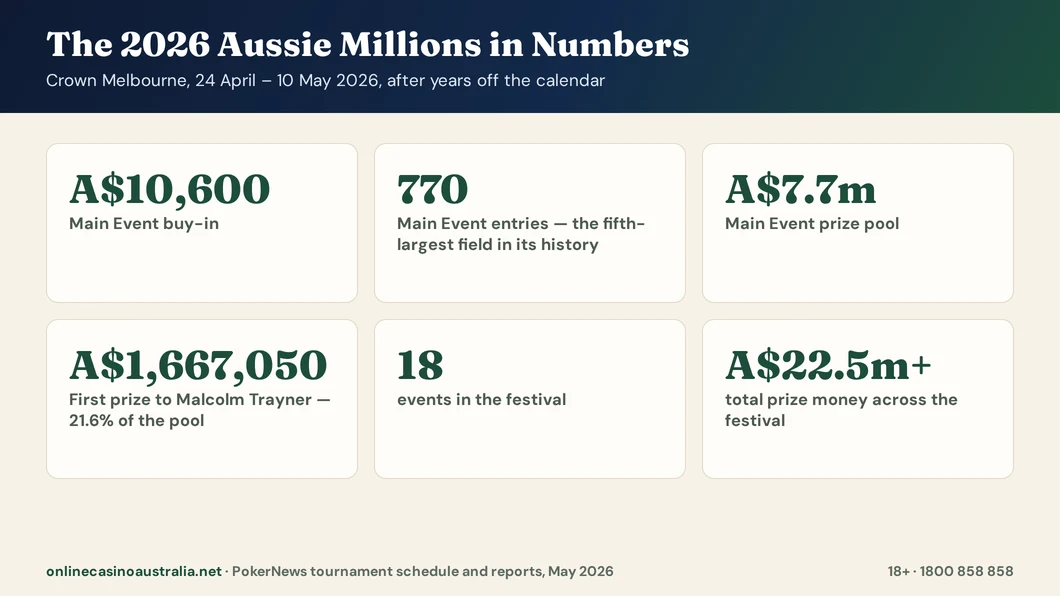
| Event | Where | 2026 numbers | Source |
|---|---|---|---|
| Aussie Millions Poker Championship | Crown Melbourne, 24 April – 10 May | 18 events; A$10,600 Main Event with 770 entries and a A$7.7m pool; more than A$22.5m in total | PokerNews schedule and reports |
| APL Million | Southport Sharks, Gold Coast (from 14 August) | 100 events; A$17,217,160 in total prize pools; A$3m guaranteed Main Event | APL |
The Aussie Millions
The Aussie Millions began at Crown Melbourne in 1998 and became one of the best-known series on the international circuit before a long break. Its return in 2026 brought a A$10,600 Main Event and buy-ins from A$1,500 to A$25,000, according to the PokerNews schedule. The 770-player Main Event was the fifth-largest field in its history.
The APL Million
The APL Million is the end point of the pub league season, where players who qualified through venue and state events meet. It is the most accessible route to a large live tournament in Australia, because qualification starts in local venues.
Casino Poker Games Are a Different Thing
Casinos also offer games with “poker” in the name in which you play against the house, not against other players. They use poker hand rankings but follow different maths: the house has a built-in edge, and no amount of skill turns it around in the long run. The same is true of the casino’s other table games — our guides to blackjack in Australia and roulette in Australia show the house edge on each.
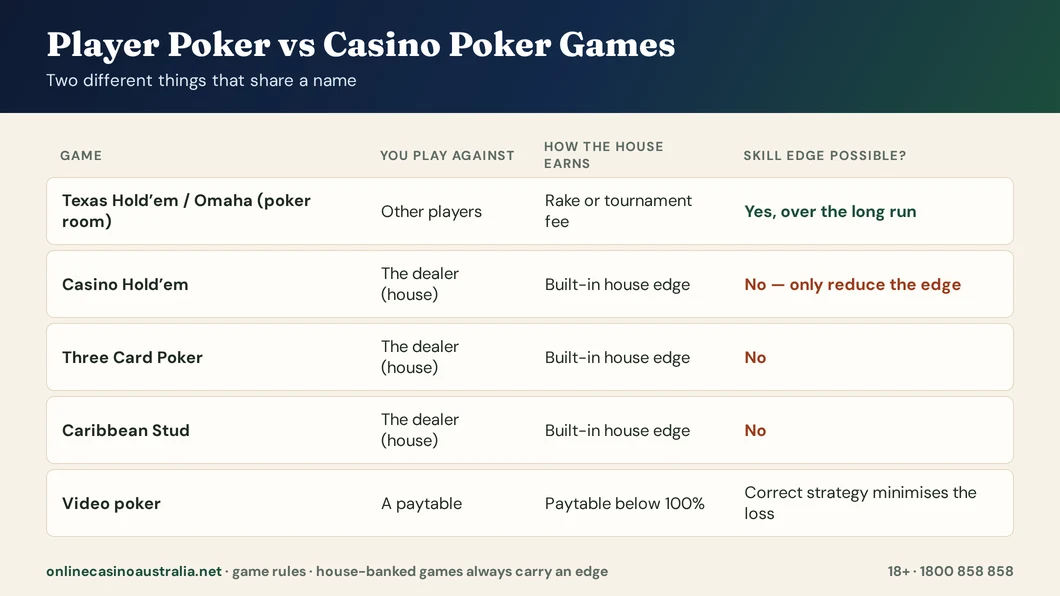
Casino Hold’em
You and the dealer each get two cards and share five community cards. You decide after the flop whether to call or fold. Good decisions reduce the house edge; they do not remove it.
Three Card Poker
A fast game where you play three cards against the dealer’s three, with optional side bets on your own hand. In three-card poker, a straight beats a flush, because it is rarer with three cards.
Caribbean Stud
Five cards each, against the dealer, with a qualifying rule for the dealer’s hand. Side bets for big hands carry a much higher house edge than the main game.
Video poker
A machine deals five cards, you choose which to hold, and you are paid according to a paytable. Paytables differ from machine to machine; the same game with a smaller payout for a full house or flush returns less. Correct strategy minimises the loss but cannot beat a paytable that returns less than 100%.
Online, all of these are casino games, and they fall under the same prohibition as online pokies and roulette. If you want to understand the house-edge maths that applies to them, our online pokies guide explains return to player (RTP) and volatility.
Your First Night in a Live Poker Room
Before you sit down
- Bring photo ID: casinos check age (18+) and identity.
- Ask the poker desk for the game list and join the waiting list for the game you want.
- Decide your budget before you arrive and bring only that. In a cash game, buy in for an amount you are comfortable losing in full.
- Learn the minimum and maximum buy-in for the table and how the house charges for the game (rake or time).
Table rules first-timers get wrong
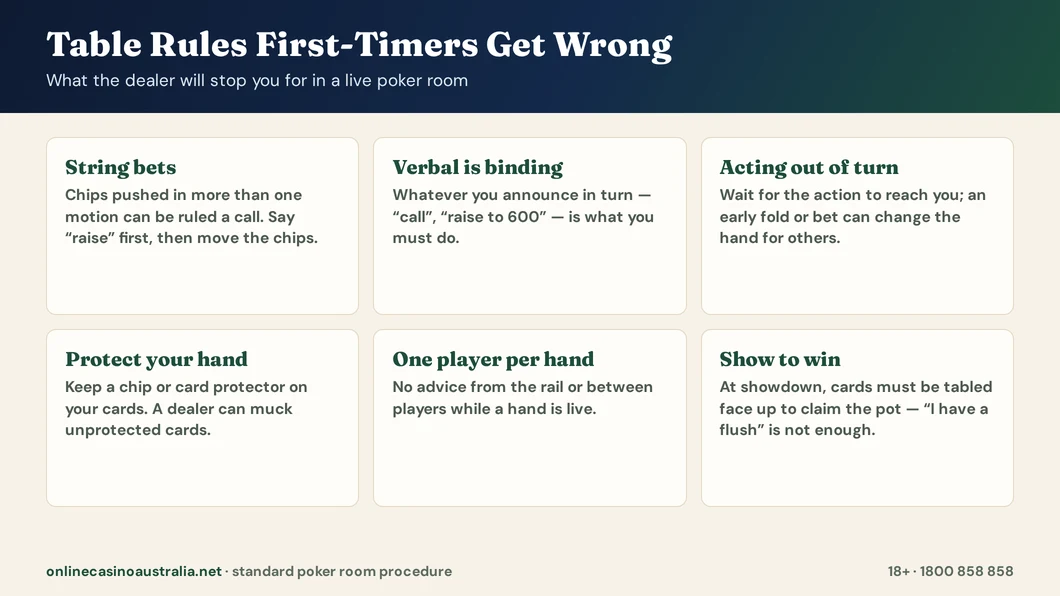
| Situation | What happens | How to avoid it |
|---|---|---|
| You push chips forward in two movements | Can be ruled a “string bet” and treated as a call | Say “raise” before moving chips, or put the full amount out at once |
| You say “call” then change your mind | Verbal declarations in turn are binding | Think first, speak second |
| You fold or bet before it is your turn | Acting out of turn can be penalised and may stand | Watch the action reach you |
| Your cards are left unattended | The dealer may muck them into the discards | Keep a chip or protector on your cards |
| A friend comments on a live hand | Not allowed — one player per hand | Discuss hands after they are over |
| You announce a flush at showdown | The hand is not read until the cards are tabled | Turn both cards face up |
From the dealer’s chair
Michael Jones, who wrote this guide, dealt poker tournaments in Europe, including EPT events. The rules in the table above are not formalities: in a live room they decide pots. Two habits solve most problems for new players: announce your action clearly before you move any chips, and keep your cards protected until the dealer pushes you the pot.
Tipping and etiquette
Tipping dealers is not expected in Australia in the way it is in some overseas rooms, and casino policies on gratuities differ. Ask the poker desk if you are unsure. Etiquette is simpler: play in turn, do not slow-roll a winning hand, and do not discuss a hand while it is still being played.
Common Mistakes New Poker Players Make
- Playing too many hands. Most starting hands lose money. Strong players fold more often than beginners expect.
- Calling without the right price. The pot-odds example above shows how often a draw is not worth chasing.
- Misreading the board. Check whether a straight or flush is possible on the community cards before you bet.
- Playing above your bankroll. A tournament field of hundreds means long runs without cashing, even for good players.
- Trusting “free chips with cash-out” offers. If chips can be sold for money, it is real-money gambling, and in Australia it is not legal to offer.
- Treating skill as protection. Skill matters over thousands of hands; in one night, luck dominates.
Free apps are a sensible place to learn the mechanics. Just remember that virtual-chip games do not reflect how people play when money is at stake — the apps themselves warn that “practice or success at social gaming does not imply future success at real money gambling”.
Bankroll: how much to set aside
A bankroll is money set aside only for poker, separate from what you need to live on. Even skilled players go through long losing runs, especially in tournaments, where most entrants win nothing. A common guideline for recreational players is to keep the cost of any single tournament or cash-game buy-in to a small fraction of the poker bankroll, so that one bad night cannot wipe it out. If you do not have a separate amount you can afford to lose in full, choose free pub league games or apps instead.
A Short Poker Glossary
| Term | Meaning |
|---|---|
| Button | The dealer position, which acts last after the flop |
| Blinds | Forced bets posted by the two players left of the button |
| Hole cards | Your two private cards in Hold’em |
| Flop, turn, river | The three, fourth and fifth community cards |
| Outs | Cards that will improve your hand to a likely winner |
| Pot odds | The price of a call compared with the size of the pot |
| Kicker | The side card that decides between equal pairs or trips |
| Rake | The house’s cut from each pot in a cash game |
| Bubble | The stage just before the paid places in a tournament |
| Re-entry | Buying back into a tournament after being knocked out |
| Muck | The discard pile; to fold your cards into it |
| String bet | A bet made in more than one motion, usually ruled a call |
Keeping Poker a Game
Poker’s skill element makes it easy to justify playing more: one more tournament to make back the last buy-in, one more session to get even. Set a monthly poker budget, count every entry and re-entry against it, and stop when it is gone. BetStop covers licensed online and phone wagering, not poker rooms or offshore sites, so for poker the tools are venue self-exclusion, your bank’s gambling block and support services. Free, confidential help is available 24/7 on 1800 858 858 and at Gambling Help Online. Our responsible gambling guide covers budgeting and blocking tools in more detail.
The Bottom Line on Online Poker in Australia
Real-money online poker cannot legally be offered to Australians, and the A$24.24 million penalties of July 2026 show the law is enforced. Poker is alive and legal offline: casino rooms for real stakes, pub leagues for regular tournaments close to home, and social apps for practice. Whichever you choose, learn the hand rankings, know the odds of your draws, and keep a firm budget. If you want to try casino games without risking money, our free demo pokies guide shows where to play official demos.
How We Put This Guide Together
Legal information comes from the Interactive Gambling Act on legislation.gov.au and from the ACMA’s media release of 6 July 2026, which we opened with an Australian IP address on 9 November 2026. Tournament figures come from the PokerNews 2026 Aussie Millions schedule and from the APL website, read the same day. App details are quoted from the Google Play listings for Australia (hl=en_AU, gl=AU), read on 9 November 2026; classification rules from classification.gov.au. Hand and drawing probabilities are our own calculations from the 2,598,960 five-card combinations and the 47 unseen cards after the flop; seven-card frequencies are from the standard enumeration of 133,784,560 hands. Search volume for “online poker australia”: 1,900 a month (Google Ads, DataForSEO, 9 November 2026). Written by Michael Jones — see how we review. 18+ only. If gambling stops being fun, call 1800 858 858.